
Fence post depth: how deep should fence posts be?
Last updated
Fence post depth is set by five things: the fence height, the post gap, what goes on top, the ground and the wind. SIMO Securon's installation manual puts intermediate posts about 75 cm deep on average, in concrete, deeper in soft ground or for taller fences. An engineer confirms the depth for each site.
What sets fence post depth?
A fence post (a fencing pole) stands because the ground around its concrete holds it upright. Anything that pushes on the fence tries to turn the post in the ground, and a deeper pit gives the ground more to hold. Five things decide how much each post has to resist.
| What | Why it matters | What it means for the depth |
|---|---|---|
| Fence height | A taller fence catches more wind, and a push near its top has a longer lever | Deeper pits and longer posts |
| Post gap | Each post carries the fence on either side of it | A wider gap means fewer pits, each a little deeper |
| What goes on top | Barbed wire and concertina coil catch wind above the fence, where the lever is longest | Deeper pits, and longer posts or arms to carry them |
| The ground | Soft clay or black cotton soil holds a post less firmly than murrum (gravelly weathered rock), gravel or rock | Deeper pits in soft ground; on rock, pits drilled or cut |
| The wind | Basic wind speeds vary by region in India (IS 875 Part 3), and open sites catch more | Deeper pits for close meshes and toppings in windy regions |
Every post also needs a minimum depth, whatever the wind: deep enough to stay firm when a person leans on it or an animal pushes against it. On many knotted fences that minimum, not the wind, sets the depth.
A post is as long as its depth in the concrete, plus the fence height, a small gap under the fence and the top fittings for any toppings. So a deeper pit means a longer post. SIMO Securon’s installation manual gives the rule of thumb: the fence height plus at least 50 cm in the foundation. Its intermediate posts go about 75 cm deep on average, adjusted to the soil and the fence height.
Why does a knotted fence need only modest pits?
Wind pushes on the wire, not on the gaps. A wall stops all of it, and a close mesh catches much of it. A high tensile knotted fence is mostly open space between its line wires and stays, so the wind passes through and its posts carry little of it, even 5 to 6 metres apart.
That is why a knotted fence’s line posts usually need pits no deeper than chain link’s posts at 2.5 to 3 metres, with around half the posts to set. Taller fences, and toppings of barbed wire or concertina coil, catch more wind, so they can need deeper pits, and an engineer works them out.
Why do end and corner posts need struts?
The line wires of a knotted fence are tensioned between end posts, so every end, corner and gate post is pulled along the fence line for as long as the fence stands. On its own, that post would lean. So each one is braced: struts (braces) run from high on the post down to a foot in the ground, and carry the pull into the ground.
A strut also lifts the post a little. The end post’s concrete must be heavy enough, and gripped by enough ground, not to rise. That is why end and corner posts sometimes need deeper pits than the line posts: in soft ground, on fences with more line wires, or with barbed wire on top. A flatter strut lifts the post less but is longer; the engineer chooses the balance for the site.
SIMO Securon’s installation manual puts terminal posts in foundations at least 45 x 45 cm and 75 cm deep, with a diagonal brace and a horizontal stay to the first post. Corner posts sit in foundations 60 x 60 cm and 75 cm deep, braced in both directions. Treat every gate post as a terminal.
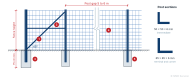
- Diagonal brace at 45 degrees on every terminal post
- Horizontal stay between the terminal and first supporting post
- Terminal foundations at least 45 x 45 cm and 75 cm deep; corners 60 x 60 cm, braced both ways
- Fabric tensioned only after the concrete has fully cured
- Posts set at least 50 cm into concrete; concrete posts at least 150 x 150 mm
Which concrete for a fence post foundation?
Fence post foundations are usually cast in M20 or M25 concrete, and the quotation names the grade. Under IS 456, M20 is the highest grade that may be made as a nominal mix, batched to a fixed recipe. M25 and above are design mixes, proportioned for the site’s own cement, sand and aggregate.
Whatever the grade, let the concrete cure before any tension goes on, and keep it damp. Wait at least 7 days with ordinary Portland cement (OPC). Wait at least 10 days with Portland pozzolana cement (PPC) or another blended cement, or in hot, dry weather: the curing periods of IS 456. Tensioning early pulls terminals out of line and loosens the whole fence.
Correct installation, posts at the right depth included, is the condition behind SIMO Securon’s rated life: 35 years or more for Alpha, 20 years for Zeta Nova and 10 years for Pi.
How deep should your fence posts be? Work it out
The fence post calculator counts the posts, struts and pits for your runs. Choose the height and the ground, and it gives the post length and the pit depth as ranges, worked out on our server. An engineer confirms the depths on site.
Work out your posts and pits
Step 1 of 5
Your result
Answer the questions, then press "Count my posts". Your result shows here.
For a whole fence, with rolls, toppings and the price range, use the fencing cost calculator, or the fence BOQ generator for a project’s runs. Every installation step is in the fixed knot fence installation guide.
FAQ
Fence post depth questions
How deep should a 6 ft fence post be?
It depends on the ground, the post gap, what goes on top and the wind. SIMO Securon's installation manual puts intermediate posts about 75 cm deep on average, deeper in soft ground; end and corner posts sit in larger foundations, braced with struts. The fence post calculator gives a range for your ground, and an engineer confirms it on site.
Fence post calculatorDo fence posts need concrete?
Yes, for a high tensile fence. Concrete gives the ground a wider, heavier block to hold than the post alone. Use M20 or M25 concrete, as the quotation names. Keep it damp before the fence is tensioned: at least 7 days with ordinary Portland cement (OPC), or 10 days with Portland pozzolana cement (PPC) or in hot, dry weather (IS 456).
Why do end posts need deeper pits than line posts?
The line wires are tensioned between end posts, so every end, corner and gate post is pulled along the fence line for as long as the fence stands. Its struts carry that pull to the ground but lift the post a little, so its concrete must be heavy and deep enough not to rise. In soft ground, or with barbed wire on top, that can mean a deeper pit.
What is a fence brace or strut?
A strut, also called a brace, is a sloping angle from high on an end, corner or gate post down to a foot in the ground along the fence line. It stops the post leaning under the fence's tension. SIMO Securon counts two struts at every strain, gate and corner post, each in a pit of its own.
How long should a fence post be?
As long as its depth in the concrete, plus the fence height, a small gap under the fence and the top fittings for any barbed wire or concertina coil. SIMO Securon's installation manual gives the rule: the fence height plus at least 50 cm in the foundation. The fence post calculator gives the length for your fence as a range.
How deep should chain link and barbed wire fence posts be?
The same five things decide it: the height, the post gap, what goes on top, the ground and the wind. Chain link posts stand closer together, 2.5 to 3 metres apart, and a barbed wire fence carries little wind, so on most ground their line posts go about as deep as a knotted fence's. Their end posts are braced with struts in the same way.
Does rocky ground need shallower pits?
Usually, because rock holds a post firmly, but the pits must be drilled or cut, and loose stony soil is not rock. Choose rocky in the calculator only where rock is at or near the surface. If you are not sure, choose not sure: the calculator works it out for normal ground, the cautious choice, and an engineer designs pits in rock for the site.
Does the wind change how deep fence posts go?
Yes, most for close meshes and fences with toppings. India's basic wind speeds vary by region (IS 875 Part 3), and an open, exposed site catches more. A knotted fence is mostly open, so the wind matters less for it than for a wall or a close mesh; on many sites the minimum depth decides instead.
Sources
- IS 456:2000, Plain and reinforced concrete, code of practice (public copy) (opens in a new tab), Bureau of Indian Standards, via Public.Resource.Org, read 27 October 2026
- IS 875 (Part 3):2015, Design loads for buildings and structures: wind loads (public copy) (opens in a new tab), Bureau of Indian Standards, via the Internet Archive, read 27 October 2026
Talk to the SIMO Securon team
Call or WhatsApp us with your site type, location and boundary length, and we will come back with a recommendation.