
- 201posts per straight km at a 5 m gap, against 401 for chain link
- 20rolls of Alpha per straight km
- About 40%faster to install than chain link
Solutions
Solar plant fencing: a perimeter fence for solar parks, rated for 35 years or more
Last updated
Solar plant fencing guards a long perimeter around panels and inverters, where replacing the fence mid-life is not an option. It is a physical fence, not a solar-powered electric fence. SIMO Securon suggests Alpha, a 6 ft Q-Knot™ fixed knot fence with Zn-Al coating, rated for 35 years or more, on around half the posts of conventional galvanised chain link.
- ISO 9001, 14001 and 45001 certified (Royal Assessments)
- Tested at NABL-accredited laboratories
- Made in Nagpur since 2023
- Installation anywhere in India
Which solar plant fencing do we suggest?
Long perimeters around a valuable asset, where replacing the fence mid-life is not an option. Designs shown are a starting point for discussion, not for construction.
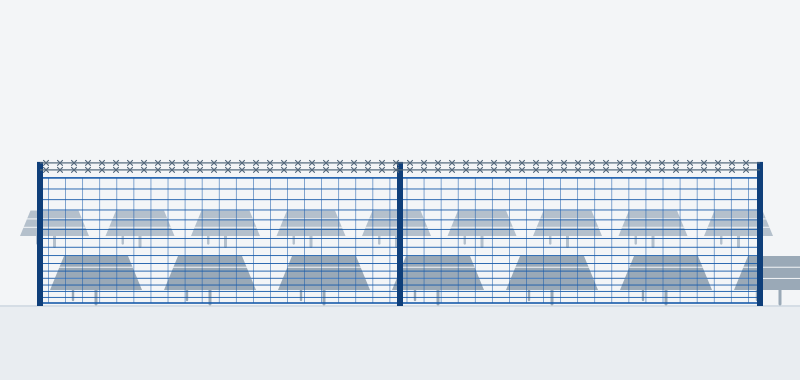
Key to the drawing
- SIMO Securon Alpha, Q-Knot graduated grid
- QvikFixrr™ GI angle post on a standard 8.5 ft shaft, with attachments for barbed wire
- Terminal post, ISA 65 x 65 x 6 mm, braced with a 45 degree strut and a horizontal stay
- Concrete foundation: terminal posts at least 45 x 45 cm and 75 cm deep
- RTHT™ reverse-twisted high-tensile barbed wire
- Grade
- Alpha (35+ years rated life)
- Technology
- Q-Knot, graduated grid
- Height
- 6 ft
- Posts
- QvikFixrr GI angle posts every 5 to 6 m
- Topping
- RTHT barbed wire
- Service
- Turnkey EPC
How many posts and rolls per km does a solar plant fence need?
A straight kilometre of SIMO Securon fence at a 5 metre post gap takes 201 posts, against 401 for conventional galvanised chain link at 2.5 metres, and Alpha's 50 m rolls make 20 rolls per kilometre.
Chain link, a knotted fence or a wall for a solar plant?
Conventional chain link: woven diamond mesh on posts every 2.5 metres. Conventional chain link
- Lowest cost at the start.
- Corrodes in 2 to 5 years in Indian conditions.
- Posts 2.5 to 3 m apart.
SIMO Securon Q-Knot knotted fence: a graduated grid with a Q-Knot at every crossing, on posts every 5 metres. SIMO Securon knotted fence
- Installed cost in line with conventional chain link.
- Around half the posts of chain link.
- Twice as fast to install as a wall.
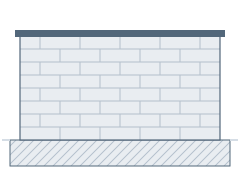
Precast or masonry wall
- Gives privacy and lasts.
- Heavy civil work and a long build over several kilometres.
- The right answer where privacy or noise is the need.
Fencing cost estimator
Work out your solar plant fence in two minutes
- Tell us about your land.
- See the fence it needs, with posts and rolls worked out.
- Get your price on WhatsApp from the SIMO Securon team.
For example, a square 5-acre site has a boundary of about 569 m: 114 posts at a 5 m gap, against 228 for conventional galvanised chain link at 2.5 m.
Or send your perimeter length on WhatsApp for a bill of quantities (opens WhatsApp).
How long will a solar plant fence last?
Supplied to leading private sector clients, including Megha Engineering, CleanMax, ENGIE, Solar Defence and Aerospace, and railway contractors.
More about solar plant fencing
What does fencing for a solar power plant have to do?
A solar plant boundary fence has to keep people and animals away from panels, cables and inverters for the life of the plant, around a perimeter that can run to many kilometres. Replacing a fence halfway through the plant’s life, around live equipment, is costly and disruptive. The same holds for other renewable energy sites: SIMO Securon supplies ENGIE with perimeter fencing for renewable assets.
This page covers the physical fence around a solar power plant or solar park: SIMO Securon makes physical perimeter fences, not electric fence energisers. For keeping nilgai and wild boar off crops, see farm fencing.
Conventional galvanised chain link costs less upfront, but it corrodes in 2 to 5 years in Indian conditions and needs a post every 2.5 to 3 metres. A precast wall lasts, but over several kilometres it means heavy civil work and a long build.
What is the specification for a solar plant fence?
SIMO Securon’s suggested solar park fence is Alpha, Q-Knot fixed knot fence, 6 ft, on QvikFixrr GI angle posts 5 to 6 m apart, with braced terminal and corner posts and an RTHT barbed wire topping.
| Part | Suggested | Why |
|---|---|---|
| Fabric | SIMO Securon Alpha, Q-Knot graduated grid | Rated for 35 years or more: Zn-Al 90/10, 240 GSM minimum, tested to 2,000 hours salt spray without red rust |
| Height | 6 ft (1.8 m); up to 8 ft (2.4 m) to order | 6 ft suits the standard 8.5 ft post shaft; 8 ft takes custom posts, made for fence supply orders of 2 km and above |
| Posts | QvikFixrr GI angle, 5 to 6 m apart: ISA 50 x 50 x 6 mm intermediate, ISA 65 x 65 x 6 mm terminal and corner | Around half the posts of conventional galvanised chain link |
| Foundations | Terminal posts at least 45 x 45 cm and 75 cm deep, braced with a 45 degree strut; corner posts 60 x 60 cm and 75 cm deep, braced both ways | Concrete fully cured before the fence is tensioned |
| Topping | RTHT high tensile barbed wire, 800 MPa | Adds a barrier against people climbing over |
| Anti-climb option | ZS-Knot™ 4 x 2 inch, in Alpha | For inverter yards, substations or frontages where people are the main threat |
What does each straight km of solar plant fence take?
| Per straight km | Comes in | Quantity |
|---|---|---|
| SIMO Securon posts at 5 m | Posts | 201 |
| SIMO Securon Alpha posts at 6 m | Posts | About 168 |
| Conventional galvanised chain link posts at 2.5 m, for comparison | Posts | 401 |
| SIMO Securon Alpha, Q-Knot | 50 m rolls | 20 |
| SIMO Securon Zeta Nova, Q-Knot | 30 m rolls | 34 |
| ZS-Knot, Alpha or Zeta Nova | 50 m rolls | 20 |
| RTHT barbed wire, per strand | Bundles of 200 m, 12 to 13 kg | 5 |
Straight runs only, rounded up. Corner, end and gate posts are braced and counted from your layout, with their struts and foundations, and QvikFixrr clips, fabric locks and fasteners are listed in the bill of quantities.
What does solar plant fencing cost per km?
SIMO Securon does not publish prices, because solar plant fencing cost per km depends on the height, grade, post section and spacing, foundations, toppings, terrain and service, from supply only to turnkey EPC. Every post saved is a hole not dug and a foundation not poured, so the installed cost of a SIMO Securon perimeter comes out in line with conventional galvanised chain link, and installation runs around 40 percent faster.
Send the perimeter length and location for a bill of quantities and a price, or read the solar park example in fencing cost in India.
Supply, install or turnkey EPC for a solar plant?
Turnkey EPC is the usual format for solar clients: site survey, engineering design to the drawings agreed with you, full supply, installation, inspection, and handover with documentation. SIMO Securon also supplies only, with training for your contractor’s team, or supplies and installs under one contract. See supply, installation and turnkey EPC.
- Lead times: About 7 days for standard rolls and 30 to 45 days for custom projects, from order confirmation.
- Capacity: SIMO WiroTEK Private Limited, which makes SIMO Securon fencing at its works in MIDC Butibori, Nagpur, has a production capacity of 28,500 MT per annum.
- Free installation tool set: one set per project, on fence supply orders of 2 km running length and above. Terms and conditions apply.
- Custom designs from 2 km: 8 ft posts, special foundations and security accessories made to suit the site.
Which solar and renewable energy companies use SIMO Securon?
SIMO Securon supplies perimeter fencing for solar assets for CleanMax and perimeter fencing for renewable assets for ENGIE. Across sectors, its private sector clients include Megha Engineering, with supply exceeding 100 km.
- CleanMax
- ENGIE
Writing the fencing specification? Test reports from NABL-accredited laboratories and SIMO’s ISO 9001, ISO 14001 and ISO 45001 certificates go to project teams on request.
Request a specification for your solar park
Tell us where the plant is and how long the perimeter is. We will send a suggested specification and a bill of quantities, and arrange a survey. Test reports and certificates are sent to project teams on request.
Thank you. We have your request.
Your reference:
What happens next
- We read the requirement and call you with any questions.
- You send the drawings and specification on WhatsApp or by email.
- We send a proposal: design, bill of quantities, programme and test documentation.
FAQ
Solar plant fencing questions
Is solar plant fencing the same as solar fencing?
No. In India, solar fencing usually means a solar-powered electric fence for farms, run by an energiser (jhatka machine). Solar plant fencing is the physical perimeter fence around a solar power plant or solar park. SIMO Securon makes the physical fence, not electric fence energisers.
What fence is used around a solar plant?
Solar plants in India are commonly fenced with conventional galvanised chain link (jali) or a precast wall; SIMO Securon offers a third option, a high tensile knotted fence with a Zn-Al coating. SIMO Securon Alpha is rated for 35 years or more and needs around half the posts of conventional galvanised chain link.
Knotted fence or chain linkWhat height should a solar plant fence be?
SIMO Securon's standard is 6 ft (1.8 m), the height that suits the QvikFixrr 8.5 ft post shaft. Where the specification asks for 8 ft (2.4 m), SIMO Securon Alpha is made up to 8 ft, with 19 line wires, on custom posts made for fence supply orders of 2 km running length and above.
Is there a 4 x 2 inch anti-climb option for inverter yards?
Yes: SIMO Securon ZS-Knot (Anti Climb) has a 4 x 2 inch grid too narrow for a toe or finger hold, in Alpha, up to 8 ft, for inverter yards, substations or frontages where people are the main threat. ZS-Knot wire is 700 to 800 MPa, the strength its knot requires.
ZS-Knot (Anti Climb) fenceOur tender specifies chain link. Can SIMO Securon supply it?
Yes: SIMO Securon supplies QvikFixrr chain link, made to order to IS 2721 (galvanised) or in Zeta Nova grade zinc-aluminium (Zn-Al) coating. Send the mesh size, wire gauge, height and length with your RFQ.
QvikFixrr chain linkWhat maintenance does a solar plant fence need?
Little: SIMO Securon's care guidance is to walk the line after storms or impacts, replace any rusted post early and keep chemicals off the fence. Conventional galvanised chain link needs rust treatment, re-tensioning and post realignment every 2 to 3 years, work that has to be done around live equipment.
Can the fence be used at a solar plant near the coast?
Only with a site-specific recommendation: SIMO Securon's standard rated life does not apply within 20 km of the coast, where sites are usually C4 or above under ISO 9223. Send SIMO Securon the location before you specify.
Specify the perimeter for your solar park
Estimate quantities for your perimeter now, or send the site location, perimeter length and drawings through the specification form above. We will propose a design, a bill of quantities and a programme.