
Fencing pole price and types: angle posts, RCC poles and FRP angles
Last updated
A fencing pole's price depends on its type, section, height and finish, and on how many the fence needs. Steel angle posts, RCC (cement) poles and FRP angles each suit different sites. SIMO Securon supplies QvikFixrr™ angle posts with its fixed knot fence, which needs a post only every 5 to 6 metres.
What types of fencing pole are there?
| Pole | What it is | Where it suits | From SIMO Securon |
|---|---|---|---|
| Steel angle post | A steel post of L-shaped section, hot-dip galvanised or epoxy coated | Wire and knotted fences; it takes attachments for barbed wire and concertina coil above the fence | QvikFixrr angle posts: 50 x 50 x 6 mm for regular spans, 65 x 65 x 6 mm at terminals and corners, on standard 8.5 ft shafts |
| RCC (cement) pole | A reinforced cement concrete post, covered by the Indian Standard IS 4996 | Barbed and plain wire farm fences; sites where steel posts are stolen for scrap, because concrete has no scrap value | RCC posts to the required specification and applicable standards, on pilferage-free designs |
| FRP angle | An angle of fibre reinforced polymer: glass fibres set in a resin, not steel | Like RCC, sites where steel posts are stolen, because it has no scrap value | FRP angles to the required specification and applicable standards, on pilferage-free designs |
| Concrete column | A cast concrete post of at least 150 x 150 mm in high-grade concrete | Knotted fences where the design calls for concrete posts | Built to the agreed drawing for the site |
The pilferage-free design pairs RCC posts and FRP angles with a 6 ft Alpha Q-Knot™ fence: see highway and railway fencing.
How do you choose a fencing pole?
- Match the pole to the fence. A high tensile fence pulls hard on its end posts, so every terminal, corner and gate post is braced, on a larger foundation, whatever the pole is made of.
- Think about theft. On long or remote boundaries where steel posts go missing for scrap, RCC posts or FRP angles remove the reason to steal them.
- Keep the posts rust-free. A rusted post shortens the life of the whole fence: steel posts should be hot-dip galvanised or epoxy coated, and replaced early if they rust.
- Count them. The post gap sets how many poles, holes and foundations the fence needs, and that usually costs more than the difference between one pole and another.
How many poles does a fence need?
| Run or square plot | Boundary | Posts at 5 m (knotted fence) | Posts at 2.5 m (chain link) |
|---|---|---|---|
| A 30 m run | 30 m | 7 | 13 |
| 1 acre | 255 m (about 840 ft) | 51 | 102 |
| 5 acres | 569 m (about 1,870 ft) | 114 | 228 |
Add the terminal, corner and gate posts for your layout: each gate adds two. The fencing cost estimator counts them for your boundary.
How deep and how far apart should the poles go?
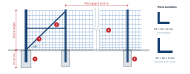
A post is the fence height plus at least 50 cm, set into concrete. Terminal posts sit in foundations at least 45 x 45 cm and 75 cm deep, corner posts 60 x 60 cm and 75 cm deep, and intermediate posts about 75 cm deep on average, adjusted to the soil. SIMO Securon’s fixed knot fence takes a post every 5 to 6 m in Alpha and every 5 m in Zeta Nova and Pi. Every step is in the fixed knot fence installation guide.
What sets the price of fencing poles?
Poles are priced each, but a boundary is measured in running metres, so compare the cost of the poles per metre of fence. The price depends on:
- The type: steel angle, RCC or FRP
- The section and thickness, and the height
- The finish: hot-dip galvanised or epoxy coated, for steel
- The number, which the post gap of the fence decides
- The foundations, bracing and installation
FAQ
Fencing pole questions
What is the price of a fencing pole?
It depends on the type (steel angle, RCC or FRP), the section and thickness, the height, the finish (hot-dip galvanised or epoxy coated, for steel) and how many you need. The count matters most: a fence with a post every 5 metres needs about half the poles of one with a post every 2.5 metres. Send your boundary on WhatsApp to +91 93730 08466 for a price.
Are cement poles better than angle posts?
Each suits a different job. RCC (cement) poles have no scrap value, so they suit sites where steel posts are stolen. Steel angle posts take attachments for barbed wire and concertina coil above the fence. For its high tensile fixed knot fence, SIMO Securon uses angle posts, or concrete columns of at least 150 x 150 mm.
What size angle post does a 6 ft fence need?
SIMO Securon's QvikFixrr angle posts for a 6 ft fence are 50 x 50 x 6 mm for regular spans and 65 x 65 x 6 mm at terminals and corners, on a standard 8.5 ft shaft: 6 ft above the ground and about 76 cm in the foundation.
How far apart should fencing poles be?
It depends on the fence. A high tensile fixed knot fence takes a pole every 5 to 6 metres; conventional galvanised chain link needs one every 2.5 to 3 metres. The Indian Standard for reinforced concrete fence posts, IS 4996, describes barbed or plain wire farm fences with line posts 3 metres apart.
Sources
- IS 4996:1984, Specification for reinforced concrete fence posts (text) (opens in a new tab), Bureau of Indian Standards, via Public.Resource.Org
Talk to the SIMO Securon team
Call or WhatsApp us with your site type, location and boundary length, and we will come back with a recommendation.