
Fence wire testing: how SIMO Securon wire is tested for strength and coating
Last updated
SIMO Securon fence wire, for its Q-Knot™ fixed knot fence, is tested at NABL-accredited laboratories for tensile strength and coating mass in every grade. Alpha is tested to 2,000 hours of salt spray (IS 9844) without red rust, and Zeta Nova to 1,200 hours; Pi's salt spray figure is an estimate. Test reports go to project buyers on request.
Which tests apply to which grade?
Every SIMO Securon grade is tested at NABL-accredited laboratories, but not every grade has every test.
| Test | Alpha | Zeta Nova | Pi |
|---|---|---|---|
| Tensile strength | IS 1608 (Part 1): 1150 to 1300 MPa (Q-Knot) | IS 1608 (Part 1): 1150 to 1300 MPa (Q-Knot) | NABL-accredited laboratory: 850 to 900 MPa |
| Coating mass | Gravimetric and gaseous volumetric methods: Zn-Al 90/10, 240 GSM minimum | IS 6745 (coating mass and adherence): Zn-Al 90/10, 120 GSM | NABL-accredited laboratory: Zinc, 80 to 100 GSM, with topcoat |
| Coating composition | X-ray fluorescence (XRF) and other advanced methods: zinc-aluminium (Zn-Al) | Not stated for this grade | Not stated for this grade |
| Salt spray | IS 9844: minimum 2,000 hours without red rust | Tested: 1,200 hours without red rust | Not tested: about 200 hours salt spray to red rust (estimated from the coating specification) |
| Coating classification | Class W10 to AS/NZS 4534:2006; Class A to BS EN 10244-2:2001 | Not stated for this grade | Not stated for this grade |
What do MPa, GSM and salt spray hours tell you?
They tell you how strong the wire is, how much coating protects it, and how long that coating holds out against corrosion.
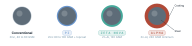
What each figure means
- Tensile strength is how much load the wire carries before it breaks, in megapascals (MPa). SIMO Securon Q-Knot wire is 1150 to 1300 MPa in Alpha and Zeta Nova and 850 to 900 MPa in Pi, against 400 to 550 MPa for conventional galvanised chain link, so it resists cutting, sagging and animal impact. ZS-Knot wire is 700 to 800 MPa in every grade.
- Coating mass is the grams of coating on each square metre of wire (GSM). More coating means more metal to be used up before the steel is exposed, and so a longer life. Standard galvanised wire carries 40 to 60 GSM.
- Salt spray is an accelerated corrosion test: wire sits in a continuous salt mist until red rust, meaning corrosion of the steel itself, appears. The longer it lasts, the better the coating protects the steel.
- Coating composition by X-ray fluorescence confirms the coating is the zinc-aluminium alloy it should be. Zn-Al is 90 percent zinc and 10 percent aluminium; how zinc-aluminium coatings compare, and how to read a coating specification, is in zinc-aluminium coatings explained.
- Adherence checks the coating stays on the wire rather than flaking off when the wire is worked.
How rated life is calculated
Rated life is how long a SIMO Securon fence is designed to last in C1 to C3 environments under ISO 9223, which typically covers inland rural areas, towns and cities, and light industry, with correct installation. It is a design figure, not a guarantee. SIMO Securon gives each grade a rated life: 35 years or more for Alpha, 20 years for Zeta Nova and 10 years for Pi, and 15 years or more for RTHT™ barbed wire.
Each figure rests on four things:
- The coating mass. Alpha carries Zn-Al 90/10, 240 GSM minimum, Zeta Nova Zn-Al 90/10, 120 GSM and Pi Zinc, 80 to 100 GSM, with topcoat, against 40 to 60 GSM on standard galvanised wire. More coating means more metal to be used up before the steel is exposed.
- Testing at NABL-accredited laboratories, for tensile strength and coating mass in every grade, as the table above sets out.
- Salt spray without red rust, to IS 9844: Alpha 2,000 hours and Zeta Nova 1,200 hours, both tested. Pi's figure, about 200 hours (estimated), comes from its coating specification.
- The environment and the installation. ISO 9223 grades how corrosive the air is, from C1 (very low) to C5 and CX (very high and extreme). C1 to C3 typically covers inland rural areas, towns and cities, and light industry. Sites within 20 km of the coast, and chemically aggressive sites, are usually C4 or above and need a site-specific recommendation. Correct installation means posts free of rust, braced terminal and corner posts in cured concrete, rolls stored dry and joined by twisting rather than welding, and fertilisers and chemicals kept off the fence.
Where rated life does not apply: sites within 20 km of the coast, or chemically aggressive sites (C4 and above), need a site-specific recommendation before you choose a grade. Send the site’s PIN code and SIMO Securon will advise.
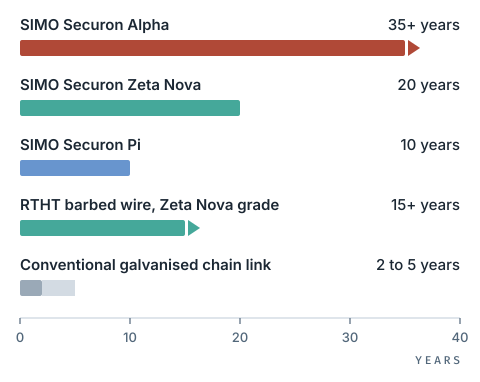
| Product | Rated life |
|---|---|
| SIMO Securon Alpha | 35+ years |
| SIMO Securon Zeta Nova | 20 years |
| SIMO Securon Pi | 10 years |
| RTHT barbed wire, Zeta Nova grade | 15+ years |
| Conventional galvanised chain link | 2 to 5 years |
The full specifications are on the Alpha knotted fence, Zeta Nova knotted fence and Pi knotted farm fence pages.
More about fence wire testing
How can you check fence wire quality before you buy?
Whoever you buy from, ask for four things in writing: the wire’s tensile strength in MPa, the coating type (zinc or Zn-Al) and its mass in GSM, the salt spray hours without red rust, and the NABL-accredited laboratory that tested it. Then compare like with like. Conventional galvanised chain link (jali) wire is 400 to 550 MPa with 40 to 60 GSM of zinc; SIMO Securon Q-Knot wire is 1150 to 1300 MPa in Alpha and Zeta Nova and 850 to 900 MPa in Pi.
A figure without a test behind it, or a salt spray figure that is an estimate but not labelled as one, is not comparable. More on choosing a fence: knotted fence vs chain link and types of fencing in India. Fencing a farm? See farm fencing.
Who does the testing?
SIMO does not itself hold NABL accreditation: the testing is done at accredited laboratories. ZS-Knot (Anti Climb) uses 700 to 800 MPa wire in every grade, which its knot requires.
Which international coating classes does SIMO Securon Alpha meet?
SIMO Securon Alpha is classified Class W10 to AS/NZS 4534:2006 and Class A to BS EN 10244-2:2001, international standards that classify metallic coatings on steel wire. These classifications are stated for Alpha only.
How is quality controlled at the Butibori works?
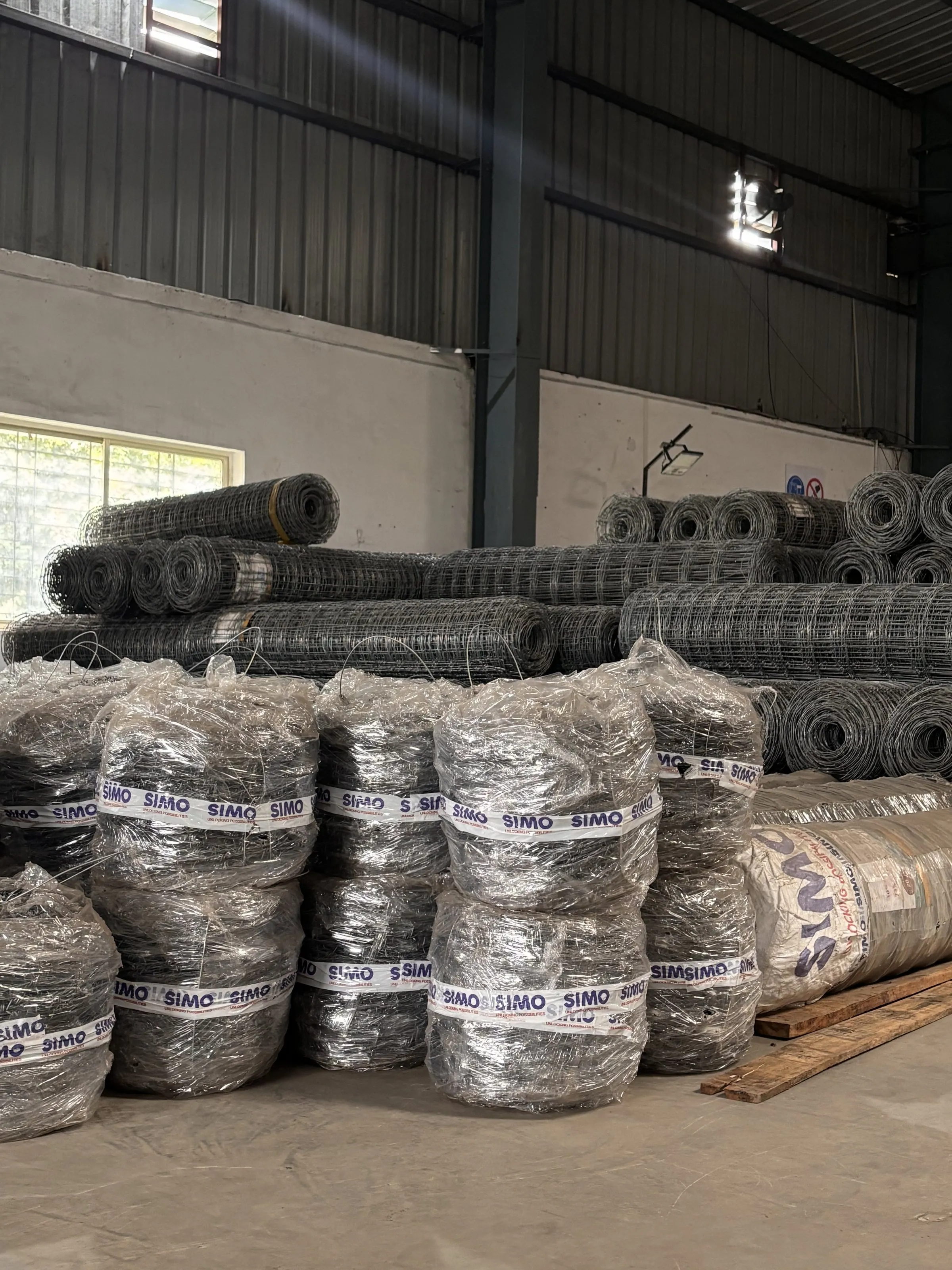
SIMO Securon fencing is manufactured at the company’s works in MIDC Butibori, Nagpur, where SIMO runs its testing and quality control, under an ISO 9001:2015 quality management system, alongside ISO 14001:2015 for environmental management and ISO 45001:2018 for occupational health and safety. See the ISO certificates and their scope and about SIMO Securon.
How do I get the test reports?
SIMO Securon sends test reports to project teams on request, with the context needed to read them, rather than posting files online. Tell us the project and the grade you are specifying in the form below. Certificates are handled the same way: see certifications. For a project quotation, see fencing supply, installation and EPC.
Request test reports
For project engineers, consultants, EPC teams and procurement. Tell us about the project and we will email the test documentation.
Thank you. We have your request.
Your reference:
What happens next
- We check the project details.
- We email what you asked for: the test reports for your grade and specification, or copies of the certificates.
FAQ
Fence wire testing questions
Are SIMO Securon products tested by an independent laboratory?
Yes. SIMO Securon Alpha, Zeta Nova and Pi are tested at NABL-accredited laboratories, which are accredited by the National Accreditation Board for Testing and Calibration Laboratories. SIMO itself is not an NABL-accredited laboratory.
What does 2,000 hours of salt spray without red rust mean?
In a salt spray test, wire sits in a continuous salt mist in a closed chamber. Red rust means the steel under the coating has begun to corrode. SIMO Securon Alpha went at least 2,000 hours, tested to IS 9844, without red rust forming.
Is SIMO Securon Pi tested for salt spray?
No. SIMO Securon Pi is tested at NABL-accredited laboratories for tensile strength and coating mass, not for salt spray. Its salt spray figure of about 200 hours (estimated) comes from the coating specification, not a test, and is always labelled as an estimate. Alpha and Zeta Nova are salt spray tested.
What is the difference between a zinc and a Zn-Al coating?
A zinc coating is zinc alone. A Zn-Al coating is a zinc-aluminium alloy, 90 percent zinc and 10 percent aluminium. SIMO Securon Alpha (Zn-Al 90/10, 240 GSM minimum) and Zeta Nova (Zn-Al 90/10, 120 GSM) are Zn-Al coated; Pi is zinc coated (Zinc, 80 to 100 GSM, with topcoat). In salt spray testing, Alpha lasted at least 2,000 hours and Zeta Nova 1,200 hours without red rust.
Can project buyers witness manufacture and testing?
Yes. SIMO Securon welcomes project buyers to witness manufacture and testing at its works in MIDC Butibori, Nagpur, and pre-despatch inspection is accepted. A trial panel can also be arranged. Ask through the form on this page.
Sources
Evaluating SIMO Securon for a project?
Tell us about the project and we will send the test documentation, and arrange a trial panel or a works inspection if you need one.