
Guide
The longest lasting fence in India, and how to choose between the types
Last updated
The longest lasting fence has a coating that suits its site and is installed correctly. Conventional galvanised chain link (jali) lasts 2 to 5 years in India; a SIMO Securon Q-Knot™ fixed knot fence is rated for 10 years (Pi) to 35 years or more (Alpha). Barbed wire (kantedar taar) is simpler, and a wall gives privacy.
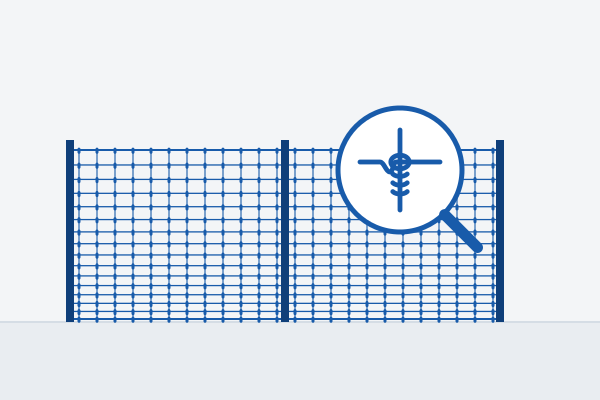
What are the main types of fencing in India?
There are four common ways to fence a boundary (tarbandi) in India: barbed wire strands, conventional galvanised chain link, a high tensile knotted fence and a precast or masonry wall. Farmers also use solar-powered electric fences to deter animals. They differ in what they stop, how long they last and how much civil work they need. Barbed wire or concertina coil can also go on top of any fence as a topping.
| Type | What it is | Good for | Watch for |
|---|---|---|---|
| Barbed wire strands | Single wires with barbs, on posts | Marking a long boundary at a low upfront cost; a topping on another fence | Open gaps that wild boar and small animals walk through |
| Conventional galvanised chain link | Woven diamond mesh of zinc-coated wire, on posts every 2.5 to 3 m | The lowest upfront cost; short, low-risk and temporary runs | Lasts 2 to 5 years in Indian conditions; sags between posts; easier to cut and climb |
| High tensile knotted fence | A grid of high-tensile wire with a fixed knot at every crossing, on posts every 5 to 6 m | Animals, long boundaries and sites that need a long rated life | Choose the grid and height for the animal |
| Anti-climb knotted grid | A close 4 x 2 inch knotted grid, up to 8 ft | People climbing: factories, warehouses, data centres | A topping and taller posts where the risk is high |
| Solar-powered electric fence | Wires carrying pulses from an energiser (jhatka machine) | Deterring animals at a lower upfront cost, where it is kept working | Needs power, regular upkeep and care around people and livestock |
| Precast or masonry wall | A continuous wall on a continuous foundation | Privacy, noise, vehicle impact | Heavy civil work and a long build |
Chain link and a knotted fence are the two wire fences most buyers weigh: knotted fence vs chain link compares them on strength, life and posts. SIMO Securon makes the Q-Knot fixed knot fence to keep animals out and ZS-Knot™ (Anti Climb) to keep people out; its 4 x 2 inch grid is the anti-climb one.
Do you need a fence or a wall?
Most farms, plots, solar parks and factories need a fence, not a wall. A wall gives privacy, screening and noise reduction, but it needs a continuous foundation and a long build. A high tensile knotted fence keeps people and animals out with equivalent strength to a precast or masonry wall, goes up about twice as fast and needs a concrete foundation only at each post.
Choose a wall where privacy or noise is the real need, and a crash barrier where vehicles are the risk. The full comparison, for plots, farmhouses and factories, is in compound wall vs fencing.
Conventional chain link: woven diamond mesh on posts every 2.5 metres. Conventional chain link
- Lowest cost at the start.
- Replaced within a few years.
- Posts 2.5 to 3 m apart.
SIMO Securon Q-Knot knotted fence: a graduated grid with a Q-Knot at every crossing, on posts every 5 metres. SIMO Securon knotted fence
- Four to six times the coating mass of chain link (Alpha).
- Takes an impact and springs back.
- Twice as fast to install as a wall.
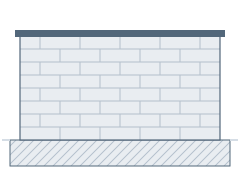
Precast or masonry wall
- Gives privacy.
- Heavy civil work and a long programme.
- The right answer where privacy or noise is the need.
Which type of fence suits which problem?
Start from what you are keeping out, not from the product. Animals need height and tight wires at ground level, people need a grid too close to climb and a topping, and privacy needs a wall. If the site is near the sea, the first step is an engineer’s advice, not a catalogue.


| Your problem | What works |
|---|---|
| Nilgai (blue bull) and cattle | A knotted fence at least 6 ft (1.8 m) high that does not bend or sag |
| Wild boar, deer and small animals | A graduated knotted grid, tight at ground level, 5 to 6 ft high |
| People climbing or cutting in | The ZS-Knot 4 x 2 inch anti-climb grid, with RTHT™ barbed wire or concertina coil on top |
| A solar park | A 6 ft knotted fence on posts 5 to 6 m apart, with barbed wire on top: see solar plant fencing |
| A factory, warehouse or data centre | The 4 x 2 inch anti-climb grid up to 8 ft, with RTHT barbed wire and concertina coil: see factory and data centre fencing |
| A highway, railway or utility corridor | A fence built to the authority’s tender specification: see railway and highway boundary fencing |
| A forest, zoo or wildlife area | An 8 ft knotted fence: see forest and zoo fencing |
| Marking a plot or farm boundary | A knotted fence such as SIMO Securon Pi, or Zeta Nova at 5 ft for a plot |
| Privacy or noise | A wall |
| Vehicles | A crash barrier, not a fence |
| A temporary boundary | Chain link, which SIMO Securon also supplies, made to order, under QvikFixrr™ |
| A site near the sea | A site-specific recommendation from an engineer |
For nilgai and cattle, SIMO Securon suggests Zeta Nova or Alpha at 6 ft; Pi suits wild boar and smaller animals. Farmers can read how to protect crops from nilgai and wild boar and cattle fencing, or see farm fencing and plot and farmhouse fencing.
How long does a fence last in India?
Conventional galvanised chain link usually lasts 2 to 5 years in Indian conditions. SIMO Securon’s knotted fence is rated for 10 years in Pi, 20 years in Zeta Nova and 35 years or more in Alpha, with correct installation. The difference is the coating: the heavier and more protective the coating on the wire, the longer before red rust breaks it.
| Fence | Coating on the wire |
|---|---|
| Conventional galvanised chain link | Zinc, 40 to 60 GSM |
| SIMO Securon Pi | Zinc, 80 to 100 GSM, with topcoat |
| SIMO Securon Zeta Nova | Zn-Al 90/10, 120 GSM |
| SIMO Securon Alpha | Zn-Al 90/10, 240 GSM minimum |
Zn-Al 90/10 is a zinc-aluminium coating of 90 percent zinc and 10 percent aluminium.
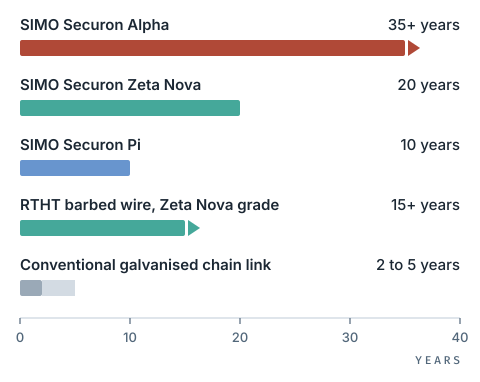
| Product | Rated life |
|---|---|
| SIMO Securon Alpha | 35+ years |
| SIMO Securon Zeta Nova | 20 years |
| SIMO Securon Pi | 10 years |
| RTHT barbed wire, Zeta Nova grade | 15+ years |
| Conventional galvanised chain link | 2 to 5 years |
Fertilisers and chemicals touching the fence, welding the fabric and rusted posts all shorten a fence’s life, whoever makes it. The three grades are compared side by side on knotted fence products.
How do you check the quality of fence wire?
Ask for three numbers and the test reports behind them: the tensile strength in MPa, the coating mass in grams per square metre (GSM) and, for coated wire, the salt spray hours without red rust. Reports should come from an NABL-accredited laboratory, to the Indian Standard for each test.
| What to ask for | Indian Standard | What it tells you |
|---|---|---|
| Tensile strength (MPa) | IS 1608 (Part 1) | How much load the wire takes before it stretches or breaks |
| Coating mass (GSM) and adherence | IS 6745 | How much protective coating the wire carries, and whether it stays on |
| Salt spray, hours without red rust | IS 9844 | How the coating stands up to corrosion in an accelerated test |

Then look at the fence itself: the height and number of line wires, the spacing of the wires at the bottom, and whether the joints are fixed knots or can slide. SIMO Securon wire is tested at NABL-accredited laboratories: tensile strength to IS 1608 (Part 1) for Alpha and Zeta Nova, salt spray to IS 9844 for Alpha, and coating mass and adherence to IS 6745 for Zeta Nova. See which tests apply to each SIMO Securon grade.
What should a fencing specification for a project include?
A specification that names the tests lets you compare bids like for like. For a solar park, a factory or any long boundary, state:
- The fence: height, number of line wires, grid and knot type.
- The wire: tensile strength in MPa, tested to IS 1608 (Part 1).
- The coating: type and mass in GSM, tested to IS 6745, and salt spray hours without red rust, tested to IS 9844.
- The posts: section, gap and foundations, with braced terminal and corner posts; see QvikFixrr posts and fittings.
- Toppings and gates: barbed wire strands or concertina coil, and where the gates go.
- Joining: rolls joined by splicing and twisting the line wires, never by welding.
- Evidence: test reports from an NABL-accredited laboratory for the wire you will receive.
SIMO Securon builds to your tender specification and shares test reports with project buyers on request. Send an RFQ with your drawing, boundary length or BOQ for a material list and proposal.
How is fencing priced in India?
Fencing is priced on the length of the boundary, its corners and gates, the height, the wire and coating, the posts and their foundations, any toppings, the site and whether installation is included. Posts are a large part of it: a fence with a post every 5 metres needs around half the posts of one with a post every 2.5 metres.
The fencing cost guide works it out per acre, per running metre and per km, and the fencing cost calculator does it for your land, with your price on WhatsApp.
How do you judge a seller’s promise on fence life?
A promise about how long a fence lasts is only as good as its written conditions. Before you buy, ask for it in writing and check what it covers, from when, what you must do to keep it, what it excludes and how you claim. A promise with no written conditions tells you little.
- What it covers: a specific failure, such as the wire breaking from rust, or something vaguer?
- From when, and for how long: from the invoice date, and for how many years?
- What you must do: register within a set time, store the fence dry, have it installed properly on sound posts.
- What it excludes: sites near the coast, chemicals and fertilisers, welding, impact, natural disasters, normal wear and tear.
- How to claim: by when, with which documents, to whom.
- Who stands behind it: a named company, with an address, that will still be there.
A design life is a different thing: how long a fence is designed to last in stated conditions, with the evidence behind it. SIMO Securon calls its design figure rated life; read how rated life is calculated.
How do you choose a fencing installer?
A fence is only as good as its installation. Choose an installer who sets posts in concrete, braces every end and corner post, lets the concrete cure before tensioning and joins rolls without welding. Ask who is responsible if something goes wrong: one contract for supply and installation is simplest.
- Posts: at the gap the fence is designed for, in concrete, with braced terminal and corner posts on larger foundations.
- Tensioning: with a fence puller and tensioners, only after the concrete has cured.
- Joining rolls: by splicing and twisting the wires, never by welding, which damages the coating.
- Fixing: clips at every post, fabric locks at strain and corner posts.
- Responsibility: one point of responsibility for the materials and the installation.
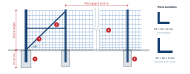
- Diagonal brace at 45 degrees on every terminal post
- Horizontal stay between the terminal and first supporting post
- Terminal foundations at least 45 x 45 cm and 75 cm deep; corners 60 x 60 cm, braced both ways
- Fabric tensioned only after the concrete has fully cured
- Posts set at least 50 cm into concrete; concrete posts at least 150 x 150 mm
SIMO Securon offers supply only, supply and installation by its own trained crews, or training for your team: see installation services. To start, let the fencing cost estimator suggest a fence and work out the posts and rolls for your land.
FAQ
Questions about the longest lasting fence
What is a high tensile knotted fence?
A high tensile knotted fence is a grid of strong steel wire with a separate wire wrapped round every crossing, so the joint cannot slip. On SIMO Securon's Q-Knot fence the line wires are also deep-crimped, so the fence springs back after an impact, and that stiffness lets posts stand 5 to 6 metres apart instead of 2.5 to 3.
Q-Knot fixed knot fenceDoes galvanised fence wire rust?
Yes, in time: the heavier and more protective the coating on the wire, the longer before red rust breaks it. Conventional galvanised chain link carries 40 to 60 GSM of zinc and usually lasts 2 to 5 years in Indian conditions. SIMO Securon Alpha carries Zn-Al 90/10, 240 GSM minimum and is tested to 2,000 hours salt spray without red rust.
How high should a boundary fence be?
A boundary fence needs the height of what it must stop. SIMO Securon suggests 5 ft (1.5 m) for a plot or farmhouse, at least 6 ft (1.8 m) wherever nilgai or cattle come, up to 8 ft (2.4 m) on the ZS-Knot 4 x 2 inch anti-climb grid where people climbing is the risk, and 8 ft for forest and zoo boundaries.
How do I fence a site near the sea?
Talk to an engineer before you buy. Salt air corrodes wire coatings much faster than inland air: sites within 20 km of the coast, and chemically aggressive sites, are usually C4 or above under ISO 9223, outside the C1 to C3 environments a rated life assumes, so they need a site-specific recommendation for the fence and the posts.
Which types of fence does SIMO Securon make?
SIMO Securon makes high tensile knotted fence in two technologies: Q-Knot, for keeping animals out, in Alpha, Zeta Nova and Pi, and ZS-Knot (Anti Climb), for keeping people out, in Alpha and Zeta Nova. It also supplies RTHT barbed wire and, under QvikFixrr, posts, fittings, concertina coil and made-to-order chain link.
Knotted fence grades and specificationsSources
- IS 14191:2024 (identical to ISO 9223:2012), Corrosion of metals and alloys: corrosivity of atmospheres: classification, determination and estimation (opens in a new tab), Bureau of Indian Standards
- IS 1608 (Part 1):2022, Metallic materials: tensile testing: method of test at room temperature (opens in a new tab), Bureau of Indian Standards
- IS 6745:1972, Methods for determination of mass of zinc coating on zinc coated iron and steel articles (opens in a new tab), Bureau of Indian Standards
Talk to the SIMO Securon team
Call or WhatsApp us with your site type, location and boundary length, and we will come back with a recommendation.