
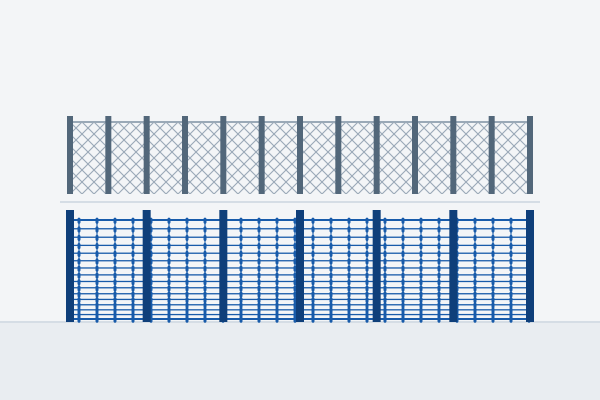
- 569 mof boundary round a square 5-acre farm
- 114posts at a 5 metre gap, for a knotted fence
- 228posts at 2.5 metres, for conventional galvanised chain link
Guide
Fencing cost in India: how to work it out per acre, per metre or per sq ft
Last updated
Fencing cost in India is worked out along the boundary, not over the area. A square acre is about 255 metres around: about 51 posts at a 5 metre gap for a SIMO Securon Q-Knot™ fixed knot fence, against about 102 at 2.5 metres for conventional galvanised chain link. Then add rolls, braced posts, fittings and installation.
What sets the fencing cost for your land?
Fencing cost is worked out along the boundary, not over the area: first the length of fence your land needs, then the fence you choose and how it is built.
What sets the price of your fence
- the boundary length, and its corners and gates
- the height and the grade (Alpha, Zeta Nova or Pi)
- the ground, and the posts and foundations it needs
- toppings: RTHT™ barbed wire or concertina coil
- supply only, or supplied and installed by SIMO’s crews
Send these to the team and your exact price comes back on WhatsApp or by phone.
Worked example: what does a 5-acre farm need?
A square 5-acre farm is about 569 metres around (about 1,870 ft). With a post every 5 metres, a knotted fence needs about half the posts of conventional galvanised chain link.
How much does fencing cost per acre, per metre, per running foot, per sq ft and per kg?
How much does fencing cost per acre?
Fencing cost per acre starts with the boundary. A square one-acre plot is about 64 metres a side and about 255 metres around, so it needs about 255 metres of fence. Measure each side of your boundary and add them up; if you only know the area, use the table below.
| Square plot | Perimeter | Posts at 5 m (knotted fence) | Posts at 2.5 m (conventional galvanised chain link) |
|---|---|---|---|
| 1 acre (40 guntha) | 255 m (about 840 ft) | 51 | 102 |
| 2 acres | 360 m (about 1,180 ft) | 72 | 144 |
| 5 acres | 569 m (about 1,870 ft) | 114 | 228 |
| 10 acres | 805 m (about 2,640 ft) | 161 | 322 |
| 1 hectare (about 2.5 acres) | 400 m (about 1,310 ft) | 80 | 160 |
One acre is about 4,047 square metres, or 40 guntha. A bigha differs from state to state, so convert it to acres or square metres first. A long, narrow plot needs more fence than a square one of the same area: an acre twice as long as it is wide is about 270 metres around, and one four times as long as it is wide about 318 metres. The post counts are for a closed boundary; every corner, end and gate also needs a braced post on a larger foundation.
The price per acre then follows from the fence you choose and how it is built: see what sets the fencing cost, at the top of this page.
How much does fencing cost per metre?
Most fencing is quoted per running metre (rmt) of boundary, and a fixed knot fence price per metre is only comparable when the rate says what it includes:
- the fence itself, its height and grade
- the posts, with their section and gap
- the foundations and the braced corner, end and gate posts
- fittings and any topping
- installation and delivery to site
A rate per running metre that leaves out the posts, their foundations or the installation is not the price of a finished fence, however low it looks. Per kilometre, a knotted fence takes 201 posts at a 5 metre gap, against 401 for conventional galvanised chain link at 2.5 metres; the full list is in the per km answer below.
How much does fencing cost per running foot?
A rate per running foot (rft) is a rate per running metre in feet: one metre is about 3.28 feet, so multiply a rate per running foot by 3.28 to compare it with a rate per running metre. A square acre is about 840 running feet around. A knotted fence has a post about every 16 feet (5 metres), against every 8 to 10 feet (2.5 to 3 metres) for conventional galvanised chain link, so a rate per running foot should also say how many posts it pays for.
How much does fencing cost per sq ft?
Fencing is priced along the boundary, not over the area, so a cost per square foot of land is really a perimeter question. A 1,200 sq ft plot (30 x 40 ft) is about 140 running feet around, and the fence for it is measured in those 140 feet, not in the 1,200 square feet.
| Plot | Boundary | Posts at 5 m (knotted fence) | Posts at 2.5 m (conventional galvanised chain link) | Rolls of Zeta Nova (30 m) |
|---|---|---|---|---|
| 1,200 sq ft (30 x 40 ft) | 140 ft (about 43 m) | 9 | 18 | 2 |
| 2,400 sq ft (40 x 60 ft) | 200 ft (about 61 m) | 13 | 25 | 3 |
| 5,000 sq ft (50 x 100 ft) | 300 ft (about 91 m) | 19 | 37 | 4 |
| 1 acre square (43,560 sq ft) | about 840 ft (255 m) | 51 | 102 | 9 |
Some sellers quote the fence fabric itself per square foot: that is the area of the fabric, its height times its length. A 6 ft fence 100 metres (about 328 feet) long is about 1,970 square feet of fabric. Multiply a per sq ft rate by the height in feet to get the fabric cost per running foot, then add the posts, fittings and installation. One square metre is about 10.76 square feet.
How much does fencing wire cost per kg?
Chain link (jali) and barbed wire (kantedar taar) are often quoted per kg; a knotted fence is sold by the roll and the running metre. To compare a rate per kg, ask for the weight per metre or per roll of that exact product:
- SIMO Securon Alpha knotted fence weighs about 1.49 kg per metre, so a 50 m roll is about 75 kg.
- RTHT barbed wire comes in bundles of 200 m, 12 to 13 kg: about 15 to 17 metres of wire per kg.
A per-kg rate pays for weight, not for strength or coating: strength comes from the wire’s tensile strength in MPa and life from its coating mass in GSM, so ask for both before you compare.
How many posts and rolls does fencing need per km?
Fencing cost per km starts with the quantities: a straight kilometre of knotted fence with a post every 5 metres needs 201 posts, against 401 for conventional galvanised chain link at 2.5 metres. Solar EPCs, industrial buyers and contractors pricing per km can use these quantities to check a bill of quantities (BOQ).
| Item | Per km of straight fence |
|---|---|
| Posts, knotted fence at 5 m | 201 |
| Posts, SIMO Securon Alpha at 6 m | 168 |
| Posts, conventional galvanised chain link at 2.5 m | 401 |
| Posts, conventional galvanised chain link at 3 m | 335 |
| Rolls, SIMO Securon Alpha (50 m) or ZS-Knot™ (50 m) | 20 |
| Rolls, SIMO Securon Zeta Nova (30 m) | 34 |
| Rolls, SIMO Securon Pi (100 ft (30.5 m)) | 33 |
| RTHT barbed wire bundles (200 m, 12 to 13 kg) | 5 per strand |
A fencing BOQ lists, line by line, without rates:
- the fence fabric, by height, grade and roll
- line posts, and terminal and corner posts with their struts
- the concrete foundation for each post
- clips at every post, and fabric locks and M10 fasteners at every strain, terminal and corner post
- toppings: barbed wire per strand, or concertina coil
- gates, counted separately
- installation, and delivery to site
For a solar plant, see the specification on solar plant fencing. For any long perimeter, send an RFQ with your drawing, boundary length or BOQ for a material list and proposal.
Fencing cost estimator
How do you get the price for your land?
- Tell us about your land.
- See the fence it needs, with posts and rolls worked out.
- Get your price on WhatsApp from the SIMO Securon team.
The SIMO Securon fencing cost estimator asks what you are fencing, what you are keeping out and how big the land is. It works out your boundary, posts and rolls on screen, against conventional galvanised chain link, and the team sends your price on WhatsApp.
More about fencing cost
How many posts (poles) does a fence need?
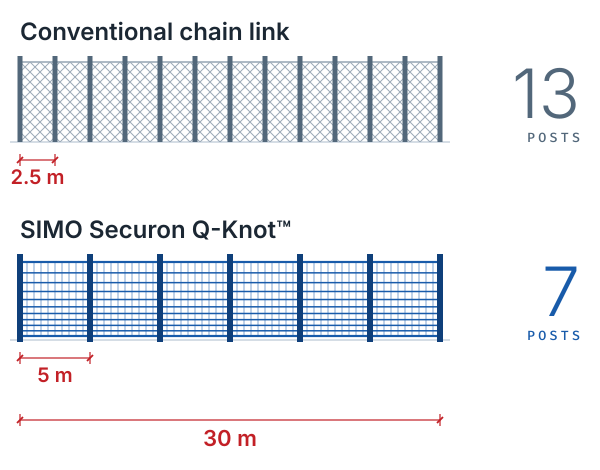
Divide the boundary length by the gap between posts. The gap is where fences differ most:
- A high tensile knotted fence stands on posts every 5 to 6 metres, because its fixed knots and crimped wires hold the fabric’s shape between them.
- Conventional galvanised chain link needs a post every 2.5 to 3 metres, because the woven mesh sags between posts.
| Straight run | Knotted fence, posts at 5 m | Conventional galvanised chain link, posts at 2.5 m |
|---|---|---|
| 30 m | 7 posts | 13 posts |
| 50 m | 11 posts | 21 posts |
Around half the posts means around half the holes to dig and fill with concrete. Steel angle posts or concrete (RCC) poles both work if they meet the standard; post sections and foundation sizes are on QvikFixrr™ posts and fittings, and why the gap differs is explained in knotted fence vs chain link.
How many rolls of fence do you need?
Divide the boundary length by the roll length of the fence you choose, and round up.
| Fence | Roll length | Rolls for a square acre (255 m) | Rolls per km |
|---|---|---|---|
| SIMO Securon Alpha, Q-Knot | 50 m | 6 | 20 |
| SIMO Securon Zeta Nova, Q-Knot | 30 m | 9 | 34 |
| SIMO Securon Pi, Q-Knot | 100 ft (30.5 m) | 9 | 33 |
| ZS-Knot (Anti Climb), Alpha or Zeta Nova | 50 m | 6 | 20 |
On long runs, rolls are joined by splicing and twisting the line wires together, which leaves the coating intact. Never weld them.
Which fittings and toppings do you need?
Besides posts and rolls, every fence needs clips at each post and fabric locks at the strain, end and corner posts. Where people are a threat, it also needs a topping.
- Clips fix the fabric to every post.
- Fabric locks and fasteners hold the fabric at every strain, end and corner post.
- Toppings: barbed wire, counted per strand along the whole boundary, or concertina coil. RTHT barbed wire comes in bundles of 200 m, 12 to 13 kg: a square acre takes about 1.3 bundles per strand, so add up the strands and round the total up (two strands take 3 bundles); a kilometre takes 5 per strand.
- Gates are counted separately.
What does fence installation include?
Installation covers the concrete for the post foundations, bracing, tensioning and labour. You can buy supply only and use your own team, with a SIMO Securon trainer alongside them if you want one; have SIMO Securon’s trained crews supply and install it under one contract; or buy turnkey EPC, from site survey to handover. Correct installation decides how long a fence lasts, so it is worth paying for. See supply, installation and turnkey EPC services.
How do you compare fencing quotes?
Turn every quote into the same unit, a price per running metre of finished fence, before you compare. Chain link, barbed wire and knotted fence are sold in different units, and posts are often priced separately:
- Per roll: divide by the roll length, and check it. SIMO Securon’s rolls alone come in 50 m, 30 m and 100 ft (30.5 m) lengths, so two prices “per roll” may not buy the same length of fence.
- Per post or per piece: count the posts at the gap the fence needs. A fence with a post every 2.5 metres needs about twice as many as one with a post every 5 metres, so a low rate for the fabric can come with twice the posts and foundations.
- Per kg or per sq ft: convert as above, then add the posts, fittings and installation.
- Per running metre or running foot: the easiest to compare, once you know what it includes.
What should every fencing quote state?
A good quote or material list lets you compare like with like. Check that it states:
- The fence: height, number of line wires and roll length.
- The wire: tensile strength in MPa, with test reports from an accredited laboratory.
- The coating: its type and mass in grams per square metre (GSM). “Galvanised” alone says little.
- The posts: how many, of what section, at what gap, with braced concrete foundations at terminal and corner posts.
- The fittings and toppings, and whether installation and delivery are included.
- Any claim about how long the fence lasts, with the conditions it assumes and what it excludes.
Comparing makers as well as quotes? See how to compare knotted fence brands.
What changes the price of a fence?
A fence’s price depends on its length, corners and gates, height, wire and coating, posts and foundations, toppings, the site and the service:
- Length: the perimeter, and how many corners and gates it has.
- Height: a taller fence needs more wire and longer posts.
- Wire and coating: stronger wire and a heavier coating cost more and last longer.
- Posts: how many, of what section, and how deep their foundations go.
- Toppings: barbed wire strands or concertina coil.
- Site: levels, soil, access and distance.
- Service: supply only, supply and install, or turnkey.
What does a 5-acre farm, a plot or a 12 km solar park need?
These three worked examples show the quantities for a typical farm, plot and solar park, with the fence SIMO Securon suggests for each.
| A 5-acre farm with nilgai and wild boar | A 2,000 m² plot or farmhouse | A 12 km solar park | |
|---|---|---|---|
| Boundary | About 569 m (square) | About 179 m (square) | 12,000 m |
| Fence SIMO Securon suggests | Zeta Nova or Alpha, Q-Knot, 6 ft (Pi where only wild boar and smaller animals come) | Zeta Nova, Q-Knot, 5 ft | Alpha, Q-Knot, 6 ft, with RTHT on top |
| Posts at 5 m | About 114 | About 36 | About 2,400 |
| Posts for conventional galvanised chain link at 2.5 m | About 228 | About 72 | About 4,800 |
| Rolls | About 19 of Zeta Nova (30 m) or 12 of Alpha (50 m) | About 6 (30 m) | About 240 (50 m) |
| Topping | None, or one RTHT strand | RTHT where security matters | RTHT: about 60 bundles per strand |
| Read more | Farm fencing | Plot boundary fencing | Solar plant fencing |
Braced corner, end and gate posts are on top of these counts. The designs are starting points for discussion, not for construction; every job is built to the drawing agreed for it. Why the farm fence is 6 ft: see how to protect crops from nilgai and wild boar.
How does fence life affect the cost?
A fence that has to be replaced every few years costs more in the end. Conventional galvanised chain link has the lowest upfront cost but usually lasts 2 to 5 years in Indian conditions. A SIMO Securon knotted fence is rated by grade and, over its life, is more cost effective:
| Specification | Pi | Zeta Nova | Alpha |
|---|---|---|---|
| Rated life | 10 years | 20 years | 35+ years |
| Against conventional galvanised chain link | Up to 30 percent more cost effective | 10 to 20 percent more cost effective, and twice the life | Up to 10 percent more cost effective, and longer lasting |
Cost comparisons depend on the site. A wall is a different decision: read compound wall vs fencing, and for every fence type, how to choose the longest lasting fence.
FAQ
Fencing cost questions
How much does it cost to fence 1 acre in India?
The cost of fencing 1 acre depends on the fence, its height, the posts and whether installation is included, so there is no single rate. A square acre needs about 255 metres of fence and, for a knotted fence with a post every 5 metres, about 51 posts. The SIMO Securon estimator works out your quantities on screen and sends your price on WhatsApp.
Fencing cost estimatorWhy does SIMO Securon give fencing quantities rather than a price per acre?
A fencing price depends on the length, height, grade, posts, toppings, site and service, so a rate printed on a page would be wrong for most sites. The quantities are predictable, so SIMO Securon publishes those. The SIMO Securon estimator works out your quantities on screen, and the team sends your price on WhatsApp, so the figure you get is for your own land.
How do I get a per km price for a long perimeter?
Send SIMO Securon a drawing, boundary length or tender BOQ through the RFQ form. Solar EPCs, industrial buyers and contractors get a material list and a proposal for the whole perimeter, and test reports from NABL-accredited laboratories on request.
Send an RFQHow do I work out fencing for land measured in bigha or guntha?
Convert the area to acres or square metres first. One acre is 40 guntha, or about 4,047 square metres; a bigha differs from state to state, so check the local figure. A square acre is about 255 metres around, and a long, narrow plot of the same area needs more fence than a square one.
Talk to the SIMO Securon team
Call or WhatsApp us with your site type, location and boundary length, and we will come back with a recommendation.