
Guide
Compound wall vs fencing: which boundary should you build?
Last updated
A compound wall, or boundary wall, gives privacy and blocks noise, but it needs a continuous foundation and a long build. A SIMO Securon Q-Knot™ fixed knot fence keeps people and animals out with equivalent strength, installs about twice as fast and needs a foundation only at each post. Choose a wall for privacy or noise.
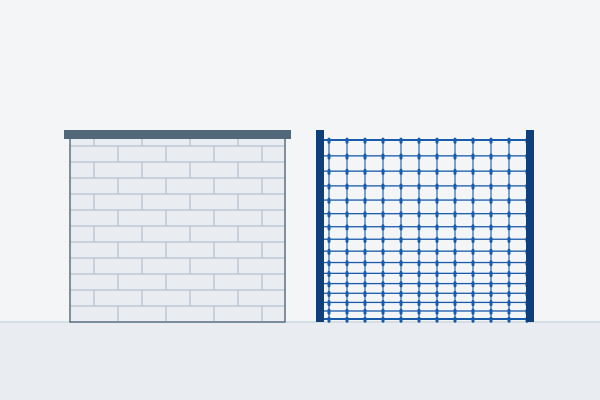
Compound wall and fencing: what does each do?
A compound wall hides and screens a property; a fence secures and marks its boundary. Most plots, farmhouses, estates and factories need the second, and a wall only where privacy or noise is the real need.
| Compared on | Precast or masonry wall | High tensile knotted fence |
|---|---|---|
| Keeps people and animals out | Yes | Yes: equivalent strength |
| Privacy and screening | Full | None: you can see through it |
| Noise reduction | Yes | No |
| Vehicle impact resistance | Yes | No: use a crash barrier where vehicles are the risk |
| Civil work | Heavy: a continuous foundation along the whole boundary | Light: a foundation at each post, every 5 to 6 m |
| Build time | Long | About twice as fast as a wall |
| Upkeep | Low | Minimal: walk the line after storms, replace a rusted post early |

For every type of fence, see how to choose the longest lasting fence. To compare a fence with chain link (jali) instead of a wall, see knotted fence vs chain link.
How much civil work does each need?
A wall needs a trench and a continuous foundation along the whole boundary, then masonry or precast panels, and time for the concrete to cure along every metre of it.
A knotted fence needs a hole and a concrete foundation only where a post stands: a post every 5 to 6 metres, with larger, braced foundations at corners, ends and gates. Terminal posts sit on at least 45 x 45 cm of concrete, 75 cm deep, and corner posts on 60 x 60 cm. Between the posts there is nothing to dig. Post sections and foundations are set out on QvikFixrr™ posts and fittings.
How long does each take to build?
A knotted fence goes up about twice as fast as a wall. Once the post foundations have cured, the fabric is unrolled, tensioned and fixed in long runs, while a wall is built course by course or panel by panel along the whole line.
Boundary wall or fencing: which keeps people and animals out?
A boundary wall and a high tensile knotted fence both keep people and animals out, if each is built for the threat. A fence is chosen by what it must stop:
- Animals (nilgai, wild boar, stray cattle and smaller animals): the Q-Knot fixed knot graduated grid, tight at the bottom, 5 to 6 ft high, and at least 6 ft where nilgai or cattle come. Farms are covered in farm fencing.
- People: a strand of RTHT™ barbed wire on top adds a strong deterrent. Where climbing is the main risk, the ZS-Knot™ (Anti Climb) 4 x 2 inch grid leaves no toe or finger hold, up to 8 ft.
Which fence does the job of a compound wall?
For most plots, farmhouses and estates, a high tensile knotted fence does the job of a compound wall. It keeps people and animals out with equivalent strength to a precast or masonry wall, goes up about twice as fast and needs a concrete foundation only at each post. SIMO Securon’s starting point for a plot is Zeta Nova Q-Knot, 5 ft, on QvikFixrr posts, with RTHT barbed wire on top where security matters: see plot boundary fencing without a wall.

Factories, warehouses and data centres where people climbing is the risk use the ZS-Knot 4 x 2 inch anti-climb grid instead: see industrial fencing.
When is a compound wall the right choice?
Build a wall when the real need is privacy, screening, noise reduction or resistance to a vehicle hitting it. A fence does not hide what is behind it. If that is what your site needs, SIMO Securon will tell you so.
How do you choose between a wall and a fence for your plot?
Decide first what the boundary must do, then get a proposal for each. For the fence, the fencing cost calculator works out the posts and rolls for your plot and sends the price on WhatsApp; for the wall, ask a civil contractor. Then weigh them on privacy and noise, build time and civil work, and how long the boundary must last. The fencing cost guide shows how a fence is priced.
FAQ
Boundary wall and fencing questions
Is a fence as strong as a compound wall?
A high tensile knotted fence such as SIMO Securon has equivalent strength to a precast or masonry wall for keeping people and animals out. It does not give privacy, noise screening or resistance to a vehicle hitting it; where those matter, a wall is the right choice.
Is a fence suitable for a factory or warehouse boundary?
Yes, where the need is security rather than privacy. For factories, warehouses and data centres, SIMO Securon suggests the ZS-Knot 4 x 2 inch anti-climb grid in Alpha, up to 8 ft, with RTHT barbed wire and concertina coil on top.
Industrial fencingHow long does a knotted fence last, and what upkeep does it need?
SIMO Securon is rated for 10 years in Pi, 20 years in Zeta Nova and 35 years or more in Alpha, with correct installation. Upkeep is light: walk the line after storms or impacts, keep fertilisers and chemicals off the fence line, and replace any rusted post early. Choose the grade by how long the boundary must last.
Talk to the SIMO Securon team
Call or WhatsApp us with your site type, location and boundary length, and we will come back with a recommendation.