
Guide
Knotted fence vs chain link: which lasts longer, and when does chain link fit?
Last updated
A high tensile knotted fence such as the SIMO Securon Q-Knot™ fixed knot fence outlasts conventional galvanised chain link (jali), which lasts 2 to 5 years in Indian conditions. It is rated for 10 years (Pi) to 35 years or more (Alpha), and its stronger wire and fixed knots need around half the posts. Chain link costs less upfront.
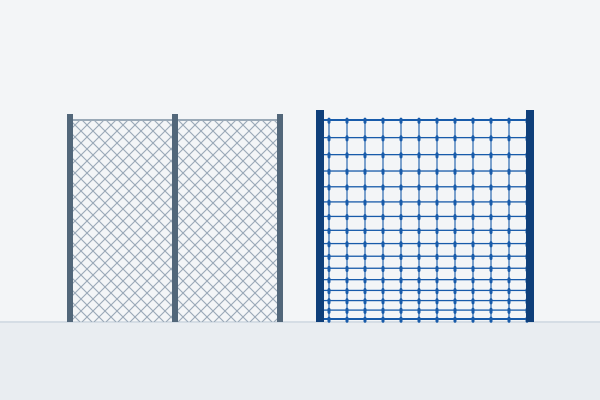
Knotted fence vs chain link (jali): how do they compare?
SIMO Securon’s high tensile knotted fence is stronger, more heavily coated and longer lasting than conventional galvanised chain link, and needs around half the posts. Chain link costs less to buy. The table sets them side by side.
| Compared on | SIMO Securon knotted fence | Conventional galvanised chain link |
|---|---|---|
| Wire strength | Q-Knot: 1150 to 1300 MPa (Alpha, Zeta Nova), 850 to 900 MPa (Pi) | 400 to 550 MPa |
| Coating | Zn-Al 90/10, 240 GSM minimum (Alpha); Zn-Al 90/10, 120 GSM (Zeta Nova); Zinc, 80 to 100 GSM, with topcoat (Pi) | Standard galvanised, 40 to 60 GSM |
| Life | Rated for 10 to 35+ years by grade | 2 to 5 years in Indian conditions |
| Post spacing | 5 to 6 metres: 7 posts per 30 m run at 5 m | 2.5 to 3 metres: 13 posts per 30 m run at 2.5 m |
| Installation | About 40 percent faster | Standard |
| Upkeep | Minimal | Rust treatment, re-tensioning and post realignment every 2 to 3 years |
| Structure | Fixed knot at every crossing, crimped wires that spring back | Woven diamond mesh; easier to cut and climb, and joints weaken over time |
| Cost | More cost effective over its life, by grade | Lowest upfront cost |
Fencing a farm against nilgai and wild boar? See farm fencing. Fencing a solar park or a long industrial perimeter, where around half the posts means less excavation and concrete? See solar plant fencing and factory and data centre fencing.
Why is knotted fence wire stronger?
Knotted fence wire is stronger because it is high-tensile: it carries more load before it stretches or breaks. Tensile strength is tested to IS 1608 (Part 1) and measured in megapascals (MPa).
| Wire | Tensile strength |
|---|---|
| Q-Knot in SIMO Securon Alpha and Zeta Nova | 1150 to 1300 MPa: up to three times conventional galvanised chain link |
| Q-Knot in SIMO Securon Pi | 850 to 900 MPa |
| Conventional galvanised chain link | 400 to 550 MPa |
Strength is only half of it. On conventional galvanised chain link the wires are woven, so they slide along each other and the mesh opens and sags. On a Q-Knot fixed knot fence a separate wire is wrapped round every crossing, so the joint cannot slip, and the deep-crimped line wires spring back after an animal or vehicle hits them. ZS-Knot™ (Anti Climb), built to keep people out, uses 700 to 800 MPa wire in every grade, which its knot requires.
Why does a knotted fence last longer?
A knotted fence lasts longer because its wire carries a heavier, more protective coating: the heavier the coating, the longer before red rust breaks the wire. Conventional galvanised chain link’s short life comes from its standard galvanised wire, with 40 to 60 GSM of zinc. Zn-Al 90/10 is 90 percent zinc and 10 percent aluminium.

| Wire | Coating |
|---|---|
| SIMO Securon Alpha | Zn-Al 90/10, 240 GSM minimum |
| SIMO Securon Zeta Nova | Zn-Al 90/10, 120 GSM |
| SIMO Securon Pi | Zinc, 80 to 100 GSM, with topcoat |
| Conventional galvanised wire | Zinc, 40 to 60 GSM |
Salt spray tests show how long a coating holds off red rust. Alpha is tested to 2,000 hours salt spray without red rust, and Zeta Nova tested to 1,200 hours salt spray without red rust. SIMO Securon wire is tested at NABL-accredited laboratories: tensile strength to IS 1608 (Part 1) for Alpha and Zeta Nova, salt spray to IS 9844 for Alpha, and coating mass and adherence to IS 6745 for Zeta Nova. See how SIMO Securon fence wire is tested.
Why does a knotted fence need around half the posts?
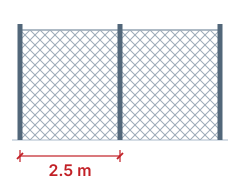
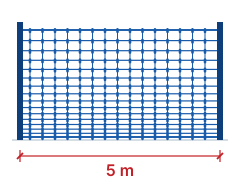
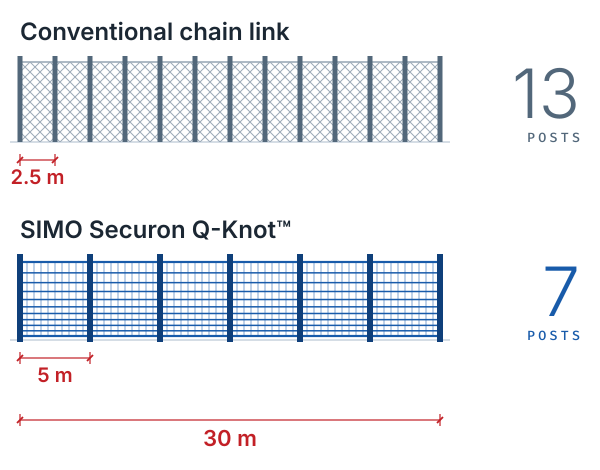
A knotted fence needs around half the posts because its knots hold the grid square and its crimped wires hold the tension, so the fabric spans 5 to 6 metres between posts. Conventional galvanised chain link needs a post every 2.5 to 3 metres to stop it sagging: on a 30 metre run, that is 13 posts instead of 7.
Fewer posts means less digging and concrete, and installation about 40 percent faster than conventional galvanised chain link. The post counts per acre and per km are in fencing cost per acre in India.
Which is harder to cut or climb?
Conventional galvanised chain link is woven, so it is easier to cut and to climb. A high tensile knotted fence is harder to cut and resists animals pushing through. Where people climbing is the main threat, the right fence is a close anti-climb grid: the 4 x 2 inch grid of SIMO Securon’s ZS-Knot (Anti Climb) leaves no toe or finger hold.

When is chain link the right choice?
Chain link has the lowest upfront cost, and it is a sensible choice for short, low-risk runs and temporary boundaries. SIMO Securon supplies chain link too, made to order as QvikFixrr™ chain link to IS 2721, galvanised or with a Zeta Nova grade zinc-aluminium (Zn-Al) coating, for a site or tender that specifies chain link. For a boundary that must last, a knotted fence is more cost effective over its life.
Is a knotted fence more expensive than chain link?
Conventional galvanised chain link costs less upfront, but it is replaced every few years and needs about twice the posts, so a SIMO Securon knotted fence is more cost effective over its life, by grade:
| Specification | Pi | Zeta Nova | Alpha |
|---|---|---|---|
| Rated life | 10 years | 20 years | 35+ years |
| Against conventional galvanised chain link | Up to 30 percent more cost effective | 10 to 20 percent more cost effective, and twice the life | Up to 10 percent more cost effective, and longer lasting |
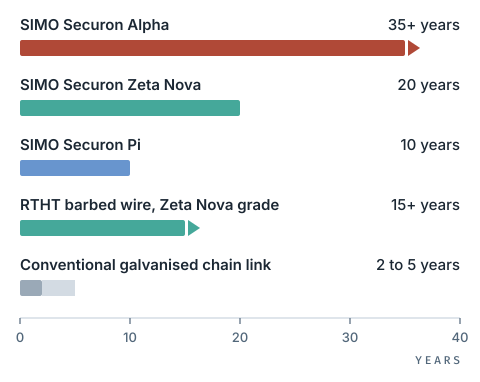
The coating sets each grade’s rated life, shown here against conventional galvanised chain link:
| Product | Rated life |
|---|---|
| SIMO Securon Alpha | 35+ years |
| SIMO Securon Zeta Nova | 20 years |
| SIMO Securon Pi | 10 years |
| RTHT barbed wire, Zeta Nova grade | 15+ years |
| Conventional galvanised chain link | 2 to 5 years |
Cost comparisons depend on the site. The cost guide shows how to work out a fence for your land, and the fencing cost calculator does it for you, with the conventional galvanised chain link post count beside it. For every other fence type, see how to choose the longest lasting fence; for a fence against a wall, compound wall vs fencing. Comparing knotted fence makers? See how to compare knotted fence brands.
FAQ
Knotted fence and chain link questions
Is chain link good enough for a farm?
For a short, low-risk run it can be: conventional galvanised chain link costs less upfront and closes the gaps that barbed wire strands leave. On a long farm boundary it sags between posts and usually lasts 2 to 5 years, while a high tensile knotted fence stays tight: for nilgai and cattle, SIMO Securon suggests Zeta Nova or Alpha at 6 ft; Pi suits wild boar and smaller animals.
Farm fencingHow long does chain link last in India?
Conventional galvanised chain link usually lasts 2 to 5 years in Indian conditions before it rusts, sags or is pushed over, because its wire carries only 40 to 60 GSM of zinc. SIMO Securon is rated for 10 years in Pi, 20 years in Zeta Nova and 35 years or more in Alpha, with correct installation.
Does a knotted fence rust?
A knotted fence can rust in time, like any steel wire: the heavier and more protective its coating, the longer before red rust breaks the wire. SIMO Securon Alpha carries Zn-Al 90/10, 240 GSM minimum and Zeta Nova Zn-Al 90/10, 120 GSM, against 40 to 60 GSM of zinc on conventional galvanised chain link. Keep fertilisers and chemicals off the fence, and replace rusted posts early.
Which costs less per metre, chain link or a knotted fence?
Conventional galvanised chain link costs less per metre to buy. A knotted fence needs a post every 5 to 6 metres instead of every 2.5 to 3, so about half the posts and foundations, and it lasts longer, so over its life a SIMO Securon fence is more cost effective: up to 10 percent with Alpha, 10 to 20 percent with Zeta Nova and up to 30 percent with Pi.
Fencing cost in IndiaIs a knotted fence suitable for a solar park?
Yes. For solar parks, SIMO Securon's starting point is Alpha Q-Knot, 6 ft, on QvikFixrr GI posts 5 to 6 metres apart, with RTHT barbed wire on top. Around half the posts of conventional galvanised chain link means less excavation and concrete, and installation about 40 percent faster.
Solar plant fencingSources
Talk to the SIMO Securon team
Call or WhatsApp us with your site type, location and boundary length, and we will come back with a recommendation.