
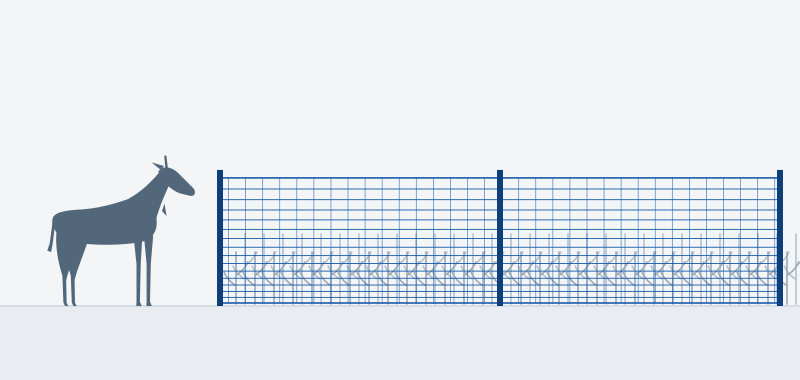
- 6 fthigh (1.8 m): the minimum SIMO Securon recommends against nilgai
- 3.5 inbetween the bottom line wires, tight where wild boar push
- About ½the posts of conventional galvanised chain link
Solutions
Farm fencing for agricultural land that keeps nilgai and wild boar out
Last updated
Farm fencing (tarbandi) that keeps nilgai and wild boar off agricultural land must be at least 6 ft (1.8 m) high, tight at ground level and stiff enough not to sag. For nilgai and cattle, SIMO Securon suggests a 6 ft Q-Knot™ fixed knot fence in Zeta Nova or Alpha; Pi suits wild boar and smaller animals.
- ISO 9001, 14001 and 45001 certified (Royal Assessments)
- Tested at NABL-accredited laboratories
- Made in Nagpur since 2023
- Installation anywhere in India
Which farm fencing do we suggest?
Crop loss to nilgai, wild boar, deer and cattle. Designs shown are a starting point for discussion, not for construction.
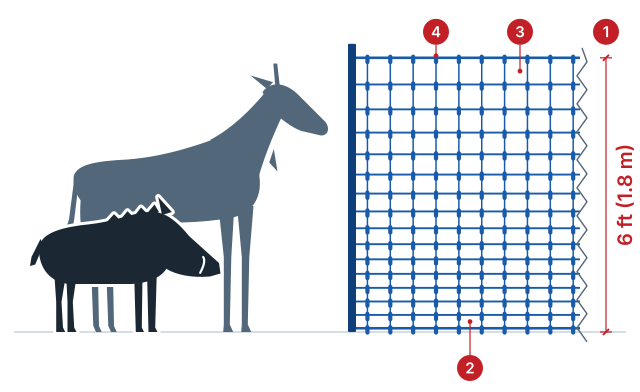
Key to the drawing
SIMO Securon Q-Knot graduated grid, 6 ft, 16 line wires.
- 6 ft (1.8 m) high: the minimum SIMO Securon recommends against nilgai.
- Line wires 3.5 in (89 mm) apart at the bottom, where wild boar and small animals push. The tight lower wires stop them.
- Wider spacing at the top, up to 7 in (178 mm), where the load is lower: less steel where it is not needed.
- A Q-Knot at every crossing, with stays every 6 in (152 mm). The knot cannot slip, and the deep-crimped line wires spring back after an impact.
- Grade
- Zeta Nova (10-year written guarantee) or Pi (5-year written guarantee)
- Technology
- Q-Knot, graduated grid
- Height
- 6 ft in Zeta Nova (or Alpha) where nilgai or cattle come in; 5 to 6 ft for wild boar and smaller animals, where Pi suits
- Posts
- QvikFixrr™ GI angle posts every 5 m
- Topping
- RTHT™ barbed wire where people are also a problem
- Service
- Supply only with training, or supply and install
How does a fixed knot fence stop nilgai and wild boar?
Height stops nilgai, tight wires at ground level stop wild boar (jungli suar), and a fixed knot at every crossing stops the wires being pushed apart. A 6 ft SIMO Securon Q-Knot fixed knot fence on the graduated grid does all three, and its deep-crimped line wires spring back after an animal pushes against them.
Chain link, a knotted fence or a wall for your farm?
Conventional chain link: woven diamond mesh on posts every 2.5 metres. Conventional chain link
- Lowest cost at the start.
- Corrodes in 2 to 5 years in Indian conditions.
- Posts 2.5 to 3 m apart.
SIMO Securon Q-Knot knotted fence: a graduated grid with a Q-Knot at every crossing, on posts every 5 metres. SIMO Securon knotted fence
- 6 ft high and tight at ground level.
- Springs back after an animal pushes it.
- Around half the posts of chain link.
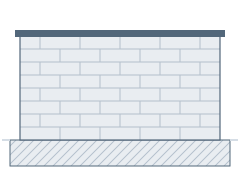
Precast or masonry wall
- Gives privacy.
- Heavy civil work and a long programme.
- The right answer where privacy or noise is the need.
Fencing cost estimator
Work out your farm fence in two minutes
- Tell us about your land.
- See the fence it needs, with posts and rolls worked out.
- Get your price on WhatsApp from the SIMO Securon team.
For example, a square 5-acre farm has a boundary of about 569 m: 114 posts at a 5 m gap, against 228 for conventional galvanised chain link at 2.5 m.
Is there a written guarantee on farm fencing?
The written guarantee is SIMO's promise in writing to retail buyers: if the wire breaks due to red rust formation within the guarantee period, SIMO replaces it, on the terms and conditions. Register within 30 days of your invoice.
By grade, retail buyers of SIMO Securon receive a 5-year written guarantee for Pi, a 10-year written guarantee for Zeta Nova and a 20-year written guarantee for Alpha, against wire breakage due to red rust formation, counted from the invoice date.
Guarantee conditions
To keep the guarantee, buy from SIMO or an authorised SIMO partner, register your purchase within 30 days of the invoice, store the fence dry before installation, and have it installed professionally on posts free of rust, following our guidance. It does not cover sites within 20 km of the coast or other corrosive environments, contact with fertilisers or chemicals, welded or jointed fabric, impact or tool damage, natural disasters, or normal wear and tear. RTHT barbed wire and QvikFixrr products, chain link included, are outside the guarantee. Claims are made within 30 days of a defect, with the invoice, proof of registration and photographs. Terms and conditions apply; the full terms are on the guarantee page. Government and public sector projects are governed by the terms of the project contract.
More about farm fencing
Fencing for agriculture land: barbed wire, chain link or a knotted fence?
A 6 ft high tensile knotted fence suits agricultural land where nilgai (blue bull) and wild boar feed: it is tall enough for nilgai, tight at ground level for boar, and stiff enough not to sag. Chain link and barbed wire cost less upfront, but most farm fences in India fail in one of three ways:
- Nilgai clear a fence that is too low, or lean on a slack one until it gives.
- Wild boar push underneath, where the bottom wires are loose or too far apart.
- The fence wears out. Conventional galvanised chain link (jali) corrodes in 2 to 5 years in Indian conditions, sags between posts and is easily pushed over, so it is replaced again and again. Compare the two in knotted fence vs chain link.
Barbed wire (kantedar taar) is simpler still, but a few strands leave open gaps that boar and small animals walk through.
Zeta Nova, Pi or Alpha: which grade suits your farm?
Choose the grade by the animals you face and how long a written guarantee you want: the SIMO Securon Zeta Nova knotted fence and the Alpha knotted fence have the stronger wire for nilgai and cattle, and the Pi knotted farm fence suits wild boar and smaller animals.
For nilgai and cattle, SIMO Securon suggests Zeta Nova or Alpha at 6 ft; Pi suits wild boar and smaller animals, at 5 to 6 ft with the wires tight at ground level. Every farm design uses the Q-Knot graduated grid. Read more in how to protect crops from nilgai and wild boar, or, for stray cattle and livestock, the stray cattle fence guide.
| Specification | Pi | Zeta Nova | Alpha |
|---|---|---|---|
| Written guarantee (retail) | 5 years | 10 years | 20 years |
| Coating | Zinc, 80 to 100 GSM, with topcoat | Zn-Al 90/10, 120 GSM | Zn-Al 90/10, 240 GSM minimum |
| Tensile strength (Q-Knot) | 850 to 900 MPa | 1150 to 1300 MPa | 1150 to 1300 MPa |
| Standard heights | 5 ft and 6 ft | 5 ft and 6 ft | 6 ft |
| Custom height | 5 ft and 6 ft only | Up to 8 ft (2.4 m) | Up to 8 ft (2.4 m) |
| Post spacing | 5 m | 5 m | 5 to 6 m |
| Choose it when | Budget matters most, and wild boar or smaller animals are the problem | Nilgai or cattle come onto the land | You want to fence once, with the longest written guarantee |
Keep fertilisers and chemicals off the fence line; where they will touch the fence, ask for a site-specific recommendation before you order.
Farming on the edge of a forest? See forest and wildlife fencing, up to 8 ft. Fencing a farmhouse plot? See plot boundary fencing.
How many posts and rolls does farm fencing need per acre?
A SIMO Securon farm fence needs a post (pole) every 5 m, against 2.5 to 3 metres for conventional galvanised chain link: around half the holes to dig and concrete. Zeta Nova comes in 30 m rolls, Pi in 100 ft (30.5 m) rolls and Alpha in 50 m rolls. For a square field:
| Square farm | Boundary | SIMO Securon posts at 5 m | Chain link posts at 2.5 m | Rolls of Zeta Nova or Pi | Rolls of Alpha |
|---|---|---|---|---|---|
| 1 acre (40 guntha) | 255 m (about 840 ft) | 51 | 102 | 9 | 6 |
| 2 acres | 360 m (about 1,180 ft) | 72 | 144 | 12 | 8 |
| 5 acres | 569 m (about 1,870 ft) | 114 | 228 | 19 | 12 |
| 10 acres | 805 m (about 2,640 ft) | 161 | 322 | 27 | 17 |
| 1 hectare (about 2.5 acres) | 400 m (about 1,310 ft) | 80 | 160 | 14 | 8 |
Counts are rounded up to whole posts and rolls. Corner, end and gate posts are braced, so add them for your layout, and a long, narrow field needs more fence than a square one of the same area. The estimator works this out for your own farm, from its area or boundary length, and sends your price on WhatsApp.
Solar fencing or a knotted fence: which suits a farm?
In India, “solar fencing” usually means a solar-powered electric fence: wires carrying pulses from an energiser (jhatka machine) that give an animal a shock. It is a different thing from a physical fence, and farmers often weigh the two.
- A solar-powered electric fence costs less upfront and deters animals where it is kept working. It needs power, regular upkeep and care around people and livestock.
- A knotted fence is a physical barrier: it keeps nilgai and wild boar out with little upkeep, and it does not depend on power.
SIMO Securon makes the physical fence, not electric fence energisers. Where you choose an electric fence, keep it maintained; where you want a barrier that works without power, choose a knotted fence.
Can your own workers install a farm fence?
Yes. With a supply-only order, SIMO Securon supplies the fence with matched QvikFixrr posts and fittings, and can send a trainer to work alongside your workers on tensioning, bracing and fixing, with instructional videos to return to. With supply and install, SIMO’s trained crews do the whole job under one contract. Professional installation following SIMO’s guidance is a condition of the written guarantee, so if you are unsure, choose supply and install. See fencing supply and installation services.
- Large farms and plantations: fence supply orders of 2 km running length and above come with one free set of installation tools per project (terms and conditions apply), and custom posts and foundations can be made to suit the land.
- Dealers: businesses that sell to farmers can apply to become authorised SIMO Securon dealers or distributors. See become a dealer.
How much does farm fencing cost?
The cost of a farm fence depends on the boundary length, the height, the grade, the corners and gates, and who installs it. The quantities per acre are predictable, as the table above shows, so your exact price comes once the team knows these. Conventional galvanised chain link costs less upfront. Measured against it over the life of the fence:
- Pi: Up to 30 percent more cost effective.
- Zeta Nova: 10 to 20 percent more cost effective, and twice the life.
- Alpha: Up to 10 percent more cost effective, and longer lasting.
Send your boundary length, height and grade on WhatsApp (opens WhatsApp) for your exact price. For the method, read fencing cost per acre in India.
FAQ
Farm fencing questions
How much does farm fencing cost per acre?
It starts with the boundary, not the area: a square acre is about 255 metres (about 840 running feet) around. That takes about 51 posts at a 5 metre gap and 9 rolls of Zeta Nova or Pi, against about 102 posts for conventional galvanised chain link at 2.5 metres. The price then depends on the grade, height, gates and who installs it; send these on WhatsApp for your exact price.
Fencing cost per acre in IndiaHow far apart are the posts on a farm fence?
A SIMO Securon farm fence in Zeta Nova or Pi has a post (pole) every 5 metres, about 16 feet; Alpha can go 5 to 6 metres. Conventional galvanised chain link needs a post every 2.5 to 3 metres, so a knotted fence needs around half the posts, with half the holes to dig and concrete.
Is a 5 ft fence enough for a farm?
SIMO Securon suggests 5 ft only where nilgai and cattle do not come. Wherever they do, choose at least 6 ft (1.8 m): for nilgai and cattle, Zeta Nova or Alpha at 6 ft. Pi suits wild boar and smaller animals, at 5 to 6 ft with the wires tight at ground level. Tell the team which animals you face, and the height is confirmed for your site before you order.
How to protect crops from nilgai and wild boarWill a farm fence hold when stray cattle lean on it?
A 6 ft SIMO Securon fence in Zeta Nova or Alpha is built for it: both use Q-Knot wire of 1150 to 1300 MPa, the deep-crimped line wires spring back after an animal pushes against them, and braced end and corner posts keep the fence tight. To keep your own livestock in, read the cattle fencing guide.
Stray cattle fence guideWhere can I buy farm fencing?
Buy direct from SIMO Securon, or from an authorised SIMO Securon dealer near you: send your PIN code on WhatsApp to +91 93730 08466 and the team will tell you the nearest. Buy from SIMO or an authorised dealer, and register your purchase within 30 days of the invoice, to keep the written guarantee.
Can fertiliser or chemicals touch a farm fence?
No: SIMO Securon's care guidance is to keep fertilisers and other chemicals off the fence, before and after installation. Where they will touch the fence line, ask for a site-specific recommendation before you order. Damage from contact with fertilisers or chemicals is not covered by the written guarantee.
Can barbed wire go on top of a farm fence?
Yes: where people and theft are also a problem, SIMO Securon adds a strand of RTHT, its reverse-twisted high tensile barbed wire of 800 MPa in Zeta Nova grade Zn-Al coating, on the QvikFixrr post attachments. RTHT is also used on its own on agricultural boundaries. RTHT barbed wire is not covered by the written guarantee.
RTHT high tensile barbed wireHow soon can farm fencing be delivered?
About 7 days for standard rolls and 30 to 45 days for custom projects, from order confirmation. Each order is confirmed individually, and delivery to your farm is planned from its PIN code.
Work out your farm fence
Tell the estimator your farm's area or boundary length, your PIN code and the animals you face. It suggests the grade and works out posts and rolls; your price comes on WhatsApp.