
Guide
Nilgai fencing: how to protect crops from nilgai and wild boar
Last updated
Nilgai fencing that protects crops needs height and a tight bottom. Nilgai (blue bull) need at least 6 ft (1.8 m) of fence that will not bend or sag; wild boar push underneath, so the lowest wires must sit about 3.5 inches apart. A SIMO Securon Q-Knot™ fixed knot fence on the graduated grid does both.
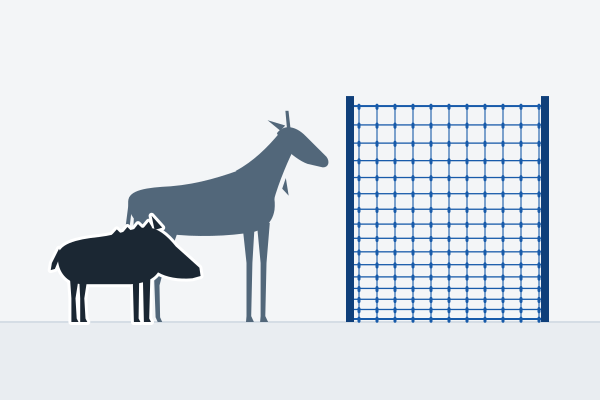
Which wild animals damage crops, and what stops each?
Nilgai (blue bull; rojda or roz in some states), wild boar (jungli suar) and deer each beat a farm fence in a different way, so the fence must be built for the animals on your land: tall and stiff for nilgai, tight at the ground for wild boar.
- Nilgai
Jump a low fence and lean on a slack one until it gives
- Wild boar
Push underneath and between loose low wires
- Deer
Push through weak or slack sections
| Animal | What it does | What stops it |
|---|---|---|
| Nilgai | Jumps a low fence; leans on a slack one | At least 6 ft (1.8 m) of fence that springs back rather than bends |
| Wild boar | Pushes underneath and between low wires | Wires about 3.5 inches apart at ground level, a bottom wire close to the ground, fixed joints |
| Deer | Pushes through weak or slack sections | A tensioned graduated grid, tight at ground level, 5 to 6 ft high |
How high should a fence be for nilgai?
A fence that keeps nilgai out must be at least 6 ft (1.8 m) high and must not bend or sag. Nilgai are large antelope: they clear a low fence, and lean on a slack one until it gives. Height alone is not enough; the fence must also stay stiff and spring back when they push, which is what high tensile wire and fixed knots do.
Wild boar fencing: how do you stop boar going under a fence?
To stop wild boar going under a fence, close the bottom. Wild boar push under a fence where the bottom wires are loose or far apart. On the Q-Knot fixed knot graduated grid in Zeta Nova and Alpha, the line wires are 3.5 inches (89 mm) apart at the bottom, rising to 7 inches (178 mm) at the top, with a stay every 6 inches (152 mm), and a knot locks every crossing so a boar cannot push the wires apart.
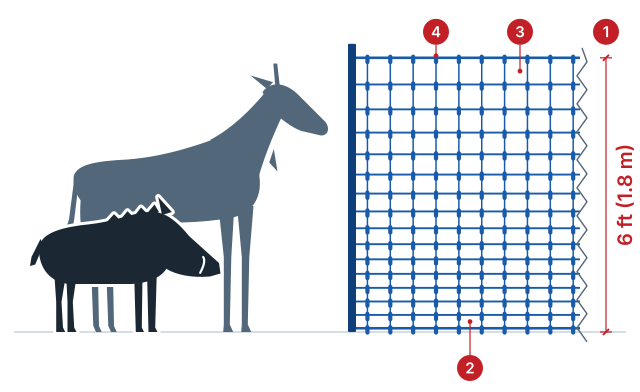
- 6 ft (1.8 m) high: the minimum SIMO Securon recommends against nilgai.
- Line wires 3.5 in (89 mm) apart at the bottom, where wild boar and small animals push. The tight lower wires stop them.
- Wider spacing at the top, up to 7 in (178 mm), where the load is lower: less steel where it is not needed.
- A Q-Knot at every crossing, with stays every 6 in (152 mm). The knot cannot slip, and the deep-crimped line wires spring back after an impact.
For wild boar and smaller animals alone, a 5 to 6 ft fence is enough, as long as the wires are tight at ground level along the whole run.
How do you keep deer out of a farm?
To keep deer out of a farm, use the same graduated grid, tight at ground level, 5 to 6 ft high. Deer push through weak or slack sections, so a tensioned fence with fixed knots and braced end posts matters more than any single wire.
Why do barbed wire and chain link fail against nilgai and wild boar?
Barbed wire (kantedar taar) strands leave open gaps that wild boar and small animals get through. Conventional galvanised chain link (jali) sags between posts and can be pushed over, and its woven joints slide under pressure, so a gap opens and stays open. Chain link does cost less upfront and suits short, low-risk runs; see knotted fence vs chain link.
A knotted fence springs back instead. Its wire is high tensile, 1150 to 1300 MPa on Q-Knot in Alpha and Zeta Nova against 400 to 550 MPa for conventional galvanised chain link, and its line wires are deep-crimped between the stays, so they stretch a little under an impact and then return to shape. Because the knots cannot slip, the fence holds its grid where an animal pushed. It also has no barbs, so the animal is turned away rather than cut.

Solar fencing or a knotted fence against nilgai?
In India, “solar fencing” usually means a solar-powered electric fence: wires carrying pulses from an energiser (jhatka machine) that give an animal a shock. Farmers often weigh it against a physical fence.
- A solar-powered electric fence costs less upfront and deters nilgai and wild boar where it is kept working. It needs power, regular upkeep and care around people and livestock.
- A knotted fence is a physical barrier: it holds its height and its tight bottom with little upkeep, and it does not depend on power.
SIMO Securon makes the physical fence, not electric fence energisers. See farm fencing for the full farm design.
How much fence and how many posts does a farm need?
A square 5-acre farm is about 569 metres around. With posts every 5 metres, a knotted fence needs about 114 posts, against about 228 for conventional galvanised chain link at 2.5 metres, plus braced corner and gate posts. A square acre is about 255 metres around.
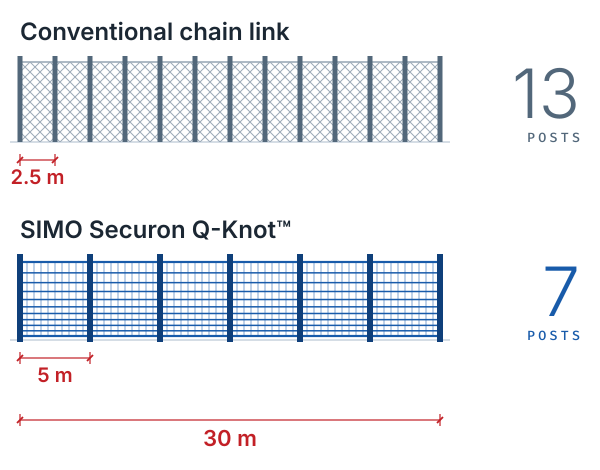
Work out your own land in fencing cost per acre in India, or answer a few questions in the fencing cost estimator and get your price on WhatsApp.
Which SIMO Securon grade suits your farm, and what written guarantee does it carry?
For nilgai and cattle, SIMO Securon suggests the Zeta Nova knotted fence or the Alpha knotted fence at 6 ft: they have the stronger wire. The Pi knotted farm fence suits wild boar and smaller animals. Choose the grade by the animal and by how long a written guarantee you want.
| Specification | Pi | Zeta Nova | Alpha |
|---|---|---|---|
| Written guarantee (retail) | 5 years | 10 years | 20 years |
| Coating | Zinc, 80 to 100 GSM, with topcoat | Zn-Al 90/10, 120 GSM | Zn-Al 90/10, 240 GSM minimum |
| Tensile strength (Q-Knot) | 850 to 900 MPa | 1150 to 1300 MPa | 1150 to 1300 MPa |
A starting point for a farm with nilgai: Zeta Nova or Alpha, Q-Knot graduated grid, 6 ft, on posts every 5 metres. Every job is built to the drawing agreed for it. Keep fertilisers and chemicals off the fence line. The full farm design is on farm fencing.
Is there a written guarantee on a fence against nilgai and wild boar?
The written guarantee is SIMO's promise in writing to retail buyers: if the wire breaks due to red rust formation within the guarantee period, SIMO replaces it, on the terms and conditions. Register within 30 days of your invoice.
By grade, retail buyers of SIMO Securon receive a 5-year written guarantee for Pi, a 10-year written guarantee for Zeta Nova and a 20-year written guarantee for Alpha, against wire breakage due to red rust formation, counted from the invoice date.
To keep the guarantee, buy from SIMO or an authorised SIMO partner, register your purchase within 30 days of the invoice, store the fence dry before installation, and have it installed professionally on posts free of rust, following our guidance. It does not cover sites within 20 km of the coast or other corrosive environments, contact with fertilisers or chemicals, welded or jointed fabric, impact or tool damage, natural disasters, or normal wear and tear. RTHT™ barbed wire and QvikFixrr™ products, chain link included, are outside the guarantee. Claims are made within 30 days of a defect, with the invoice, proof of registration and photographs. Terms and conditions apply; the full terms are on the guarantee page. Government and public sector projects are governed by the terms of the project contract.
How should a farm fence be installed to keep animals out?
A farm fence keeps animals out only if it is installed tight and braced:
- Posts every 5 metres, with the bottom wire close to the ground along the whole run.
- Braced end and corner posts on larger concrete foundations: the bracing is set out in the stray cattle fence guide.
- Tension only after the concrete has cured, so the posts do not lean.
- Walk the line after storms or impacts, and replace any rusted post early.
- Diagonal brace at 45 degrees on every terminal post
- Horizontal stay between the terminal and first supporting post
- Terminal foundations at least 45 x 45 cm and 75 cm deep; corners 60 x 60 cm, braced both ways
- Fabric tensioned only after the concrete has fully cured
- Posts set at least 50 cm into concrete; concrete posts at least 150 x 150 mm
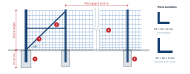
Professional installation following SIMO’s guidance is a condition of the written guarantee. If you are not sure your team can do it, choose supply and install, or ask for a trainer to work with your team. See installation services.
How is a forest, zoo or wildlife fence different?
Keeping animals in a reserve or zoo, or out of a forest boundary, is a different job from protecting crops: SIMO Securon suggests an 8 ft fence, Q-Knot in Alpha or Zeta Nova. See forest and zoo fencing.
For stray cattle and livestock, read the stray cattle fence guide. Sell fencing to farmers in your area? SIMO Securon appoints authorised dealers: see become a SIMO Securon dealer.
FAQ
Nilgai and wild boar fencing questions
Do nilgai jump fences?
Yes: nilgai clear a low fence, and lean on a slack one until it gives. That is why SIMO Securon recommends a high tensile knotted fence at least 6 ft (1.8 m) high against nilgai, one that stays stiff and springs back when they push.
Is barbed wire enough for wild boar?
Barbed wire alone is usually not enough for wild boar: its strands leave open gaps that boar and small animals push through. A knotted fence closes the gaps. If people are also a problem, a strand of RTHT barbed wire can run along the top of the knotted fence.
RTHT barbed wireWill a knotted fence injure wild animals?
No: a knotted fence has no barbs. It holds animals back without injuring them, because an animal that pushes against it meets a stiff grid of wire that springs back, and is turned away rather than cut. That matters on farm boundaries next to forest land and grazing.
Talk to the SIMO Securon team
Call or WhatsApp us with your site type, location and boundary length, and we will come back with a recommendation.