
Guide
High tensile fence: the wire, the post spacing and the installation
Last updated
A high tensile fence is a wire fence made from high tensile steel wire, which is stronger and springier than ordinary low-carbon steel wire, so it stays tight between posts set far apart. SIMO Securon's high tensile fences are the Q-Knot™ fixed knot fence, with wire of 850 to 1300 MPa by grade, and RTHT™ high tensile barbed wire.
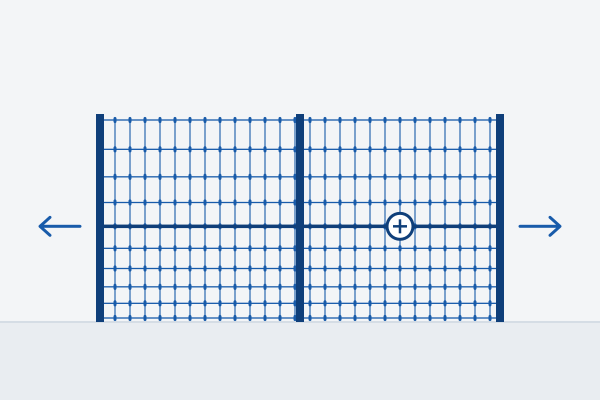
What makes fence wire high tensile?
Tensile strength is how much pulling load a wire carries before it breaks, measured in megapascals (MPa) and tested to IS 1608 (Part 1). High tensile wire is made from steel with a higher carbon content than ordinary low-carbon fence wire, so it is stronger and springier: it holds its tension, and it takes a push or a knock and returns to shape.
| Wire | Tensile strength |
|---|---|
| SIMO Securon Q-Knot, Alpha and Zeta Nova | 1150 to 1300 MPa |
| SIMO Securon Q-Knot, Pi | 850 to 900 MPa |
| SIMO Securon ZS-Knot™, all grades | 700 to 800 MPa |
| SIMO Securon RTHT barbed wire | 800 MPa |
| Conventional galvanised chain link | 400 to 550 MPa |
That makes the Q-Knot wire in Alpha and Zeta Nova up to three times stronger than conventional galvanised chain link.
Why does a high tensile fence need fewer posts?
Strong wire holds its tension over a longer span, and in a fixed knot fence every crossing is locked, so the mesh cannot be pushed apart between posts. Together they keep the fence rigid enough for a post every 5 to 6 metres, against 2.5 to 3 metres for conventional galvanised chain link. On a 30 metre run that is 7 posts against 13: around half the posts, with less digging and concrete, and installation about 40 percent faster.
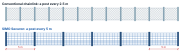
The line wires are also crimped between the stays. The crimps act as springs, so the fence absorbs an animal’s push and springs back instead of sagging. See fixed knot fence for how the knot and crimp work.
What is the post spacing for a high tensile fence?
| Fence | Post spacing | Posts on a 30 m run |
|---|---|---|
| SIMO Securon Alpha | 5 to 6 m | 7 at 5 m |
| SIMO Securon Zeta Nova | 5 m | 7 |
| SIMO Securon Pi | 5 m | 7 |
| Conventional galvanised chain link | 2.5 to 3 m | 13 at 2.5 m |
Every corner, change of direction and gate post is a braced terminal on a larger foundation. The fencing cost estimator counts the posts for your boundary.
How is a high tensile fence installed?
High tensile wire stores more energy under tension than ordinary wire, so it is installed with braced ends and tensioned with care:
- Terminal and corner posts are braced with a diagonal strut at 45 degrees and a horizontal stay, on foundations 75 cm deep.
- The concrete cures for at least 7 days (OPC) or 10 days (PPC, or in hot, dry weather) before any tension goes on.
- Each line wire is tensioned to 0.8 kN (about 80 kgf), checked with a wire tension meter, without pulling the crimps flat.
- Rolls are joined by splicing and twisting, never by welding.
- Nobody stands in line with a wire under tension: a released high tensile wire can whip.
- Diagonal brace at 45 degrees on every terminal post
- Horizontal stay between the terminal and first supporting post
- Terminal foundations at least 45 x 45 cm and 75 cm deep; corners 60 x 60 cm, braced both ways
- Fabric tensioned only after the concrete has fully cured
- Posts set at least 50 cm into concrete; concrete posts at least 150 x 150 mm
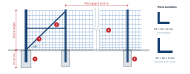
Every step is in the fixed knot fence installation guide.
Which high tensile fence suits your site?
- To keep animals out (nilgai, wild boar, cattle, deer): the Q-Knot fixed knot fence on its graduated grid, at 6 ft wherever nilgai or cattle come. See farm fencing.
- To keep people out: the ZS-Knot 4 x 2 inch anti-climb knotted fence. Its wire is 700 to 800 MPa, the strength the ZS-Knot needs. See industrial fencing.
- As a topping, or on its own on a farm boundary: RTHT high tensile barbed wire, reverse twisted, 15.5 x 15.5 SWG.
How long each lasts depends on its coating: SIMO Securon is rated for 35 years or more in Alpha, 20 years in Zeta Nova and 10 years in Pi, and RTHT for 15 years or more.
Who installs high tensile fences?
SIMO Securon’s own trained crews install its high tensile fence anywhere in India once an order is confirmed, to SIMO’s standards of foundations, bracing and tension. If you have a contractor, a SIMO trainer can work alongside the team instead. See fencing contractor.
FAQ
High tensile fence questions
What is high tensile fence wire?
High tensile fence wire is steel wire with a higher carbon content and a much higher tensile strength than ordinary low-carbon wire, measured in megapascals (MPa). SIMO Securon's Q-Knot wire is 1150 to 1300 MPa in Alpha and Zeta Nova and 850 to 900 MPa in Pi, against 400 to 550 MPa for conventional galvanised chain link.
Is high tensile wire the same as GI wire?
No: they describe different things. High tensile describes the steel's strength; GI (galvanised iron) describes a zinc coating. A wire can be both. SIMO Securon's high tensile fence wire carries a zinc-aluminium (Zn-Al) coating in Alpha and Zeta Nova, and a zinc coating with a topcoat in Pi.
What is the post spacing for a high tensile fence?
A SIMO Securon high tensile fixed knot fence takes a post every 5 to 6 metres in Alpha and every 5 metres in Zeta Nova and Pi, against 2.5 to 3 metres for conventional galvanised chain link: around half the posts.
Can high tensile fence wire be welded?
No. Never weld or joint high tensile fence fabric, even for a repair. Rolls are joined by splicing and twisting the line wires together, which leaves the coating intact.
Are there high tensile fence installers near me?
SIMO Securon's own trained crews install its high tensile fence anywhere in India once an order is confirmed, or a trainer can work alongside your own contractor. Send your site PIN code on WhatsApp to +91 93730 08466.
Fencing contractorTalk to the SIMO Securon team
Call or WhatsApp us with your site type, location and boundary length, and we will come back with a recommendation.