
Guide
Farm fencing subsidy (tarbandi yojana): a state-by-state guide
Last updated
A tarbandi yojana is a state scheme that pays part of the cost of fencing a farm: a share of the cost, up to a cap per farmer, often with a minimum land holding, and you apply online on the state's portal. Schemes differ by state and change each year, and SIMO Securon does not run them.

How do farm fencing subsidy schemes work?
Most state schemes for farm fencing (tarbandi, खेत की तारबंदी योजना) work the same way:
- A share of the cost, often a larger share for small and marginal farmers or for farmers who fence together as a group.
- A cap, per farmer, per running metre or per hectare.
- Conditions: a minimum land holding, a type of fence, and sometimes a limit of once per farmer or once in ten years.
- An online application on the state’s agriculture portal, with your land record, Aadhaar and bank details, followed by a sanction and a site inspection.
SIMO Securon does not run these schemes and cannot confirm your eligibility. Ask your agriculture or horticulture officer. Many schemes name barbed wire or solar fencing as the fence they pay for, so ask the officer, before you buy, whether a knotted fence qualifies under your scheme. SIMO Securon can give a quotation and invoice in the form the officer asks for.
Which states have a farm fencing subsidy?
These are the schemes we could read on an official government page: a state portal or department website, or myScheme, the Government of India’s scheme portal. Each row links to its source.
Last checked: 17 October 2026. Schemes change every budget year: check the official page before you apply.
| State and scheme | What it pays for | Assistance and conditions, as published | How to apply, and the official source |
|---|---|---|---|
| Rajasthan: Khet ki Tarbandi (Kantedar Tarbandi Yojana) | Fencing round the fields; myScheme describes it as barbed wire fencing | Small and marginal farmers: 60 percent of the cost, up to ₹48,000. Other farmers: 50 percent, up to ₹40,000. A group of 10 or more farmers with at least 5 hectares together: 70 percent, up to ₹56,000 per farmer. Up to 400 running metres per farmer.At least 1.5 hectares in one place (0.5 hectare in Scheduled Tribe areas). For the current financial year. | Online on Raj Kisan Saathi with your Jan Aadhaar, or at an e-Mitra centre. The site is geotagged before and after fencing. Portal for Khet ki Tarbandi (Kantedar Tarbandi Yojana) (opens in a new tab)Source: Raj Kisan Saathi, Agriculture Department, Rajasthan: farm fencing (opens in a new tab); myScheme: Khet ki Tarbandi (opens in a new tab) |
| Gujarat: Wire fencing around the farm for crop protection | Wire fencing round the farm | Assistance per running metre of fencing, up to half the actual cost, only once per farmer, as published on myScheme. News reports in May 2026 said the rate and the minimum land were revised: check the current figures on i-Khedut.As published on myScheme: farmers in a cluster of at least 2 hectares; not for farmers who took the solar fencing assistance. | Online on i-Khedut, or through a Common Services Centre. Portal for Wire fencing around the farm for crop protection (opens in a new tab)Source: myScheme: Wire fencing around the farm for crop protection (Gujarat) (opens in a new tab) |
| Gujarat: Assistance to buy a solar power unit for solar fencing | The solar power unit (energiser kit) of a solar-powered electric fence round the farm | 50 percent of the actual cost, up to ₹15,000, once in 10 years.Not for farmers who took the wire fencing assistance. | Online on i-Khedut. Portal for Assistance to buy a solar power unit for solar fencing (opens in a new tab)Source: myScheme: Solar power unit for solar fencing (Gujarat) (opens in a new tab) |
| Maharashtra: Dr. Shyamprasad Mukherjee Jan-Van Vikas Yojana (solar fencing) | Solar fences for farms in villages within 2 km of the buffer zone of a tiger reserve or a protected wildlife area | The forest department bears three quarters of the cost, up to ₹15,000; the farmer pays the rest, a quarter (₹5,000) or more.Villages within 2 km of a tiger reserve buffer or protected area only. | Online on MahaDBT, with Aadhaar, the 7/12 extract and a bank passbook. Portal for Dr. Shyamprasad Mukherjee Jan-Van Vikas Yojana (solar fencing) (opens in a new tab)Source: MahaDBT: Dr. Shyamprasad Mukherjee Jan-Van Vikas Yojana (opens in a new tab) |
| Himachal Pradesh: Mukhyamantri Krishi Utpadan Sanrakshan Yojana | Solar-powered fences, interlink chain fences, solar-interlinked chain fences and barbed wire fences | 70 percent of the cost, since 2023-24; the farmer pays 30 percent. Subject to the budget available.Solar fences are built by service providers registered with the department; chain link and barbed wire fences are put up by the farmer, to the department guidelines. | Online on agridbt.hp.gov.in, or through the Subject Matter Specialist at the block office. Portal for Mukhyamantri Krishi Utpadan Sanrakshan Yojana (opens in a new tab)Source: Department of Agriculture, Himachal Pradesh: Mukhyamantri Krishi Utpadan Sanrakshan Yojana (opens in a new tab); Department of Agriculture, Himachal Pradesh: Citizen Charter 2024-25 (opens in a new tab) |
| Uttarakhand: Scheme for Fencing in Gardens | Fencing round orchards and horticulture crops against wild animals | 50 percent of the total cost, up to ₹1 lakh per hectare.Farmers in Uttarakhand with a valid Udhyan card. | Offline, at a Horticulture Mobile Team Centre.Source: myScheme: Scheme for Fencing in Gardens (Uttarakhand) (opens in a new tab) |
We could not read a scheme on an official page for Uttar Pradesh, Madhya Pradesh, Karnataka, Tamil Nadu, Telangana or Andhra Pradesh, or a statewide wire fencing scheme for Maharashtra, so none is listed for them. That does not mean none exists: ask your district agriculture or horticulture office. This page is checked every quarter.
How do you apply for a farm fencing subsidy?
- Ask the officer firstCheck your eligibility, the fence the scheme pays for, and whether a knotted fence qualifies.
- Gather your papersYour land record (jamabandi in Rajasthan, the 7/12 extract in Maharashtra, the 8-A in Gujarat), Aadhaar, and bank details.
- Apply onlineOn your state's portal, or at an e-Mitra or Common Services Centre where the scheme allows it.
- Wait for the sanction before you fenceSome schemes inspect the site before and after: Rajasthan geotags it at both stages.
- Keep the quotation and invoiceIn the form the officer asks for, and claim the assistance once the fence is up.
Which fence should you put up?
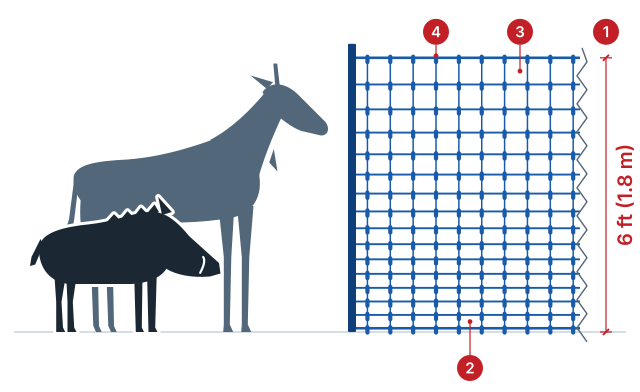
Choose the fence for your animals first, then check what your scheme pays for. Against nilgai (blue bull) and cattle, a fence must stand at least 6 ft and stay stiff; against wild boar, it must be tight at ground level. A solar-powered electric fence costs less upfront and deters animals while it is kept working; a knotted fence is a physical barrier that works without power. See farm fencing, the cheapest fencing for a farm, and how to protect crops from nilgai and wild boar. The fencing cost estimator works out the posts and rolls for your land.
FAQ
Tarbandi yojana questions
What is tarbandi yojana?
Tarbandi means fencing, and a tarbandi yojana is a state government scheme that pays part of the cost of fencing a farm against animals. The one most searched for is Rajasthan's Khet ki Tarbandi (Kantedar Tarbandi Yojana); other states run their own schemes, some for wire fencing and some for solar-powered electric fences.
How do I apply for tarbandi yojana online?
On your state's agriculture portal: Raj Kisan Saathi in Rajasthan, i-Khedut in Gujarat, MahaDBT in Maharashtra, agridbt in Himachal Pradesh. You usually need your land record, Aadhaar and bank details. Apply, and wait for the sanction, before you put up the fence: some schemes inspect the site before and after.
Does the subsidy cover a knotted fence?
It depends on the scheme. Many schemes name barbed wire or solar fencing as the fence they pay for. Ask your agriculture or horticulture officer, before you buy, whether a knotted fence qualifies under your state's scheme. SIMO Securon can give a quotation and invoice in the form the officer asks for.
Is there a farm fencing subsidy in Maharashtra?
On 17 October 2026, MahaDBT listed the Dr. Shyamprasad Mukherjee Jan-Van Vikas Yojana, which pays most of the cost of a solar fence for farms in villages within 2 km of a tiger reserve buffer or protected wildlife area. We found no statewide wire fencing scheme on MahaDBT; ask your taluka agriculture office.
Does SIMO Securon help with the subsidy application?
SIMO Securon does not run these schemes and cannot confirm your eligibility: the agriculture or horticulture officer decides. What SIMO can do is give a quotation and an invoice in the form the officer asks for, and supply and install the fence once your application is sanctioned.
Sources
- Raj Kisan Saathi, Agriculture Department, Rajasthan: farm fencing (opens in a new tab), Government of Rajasthan, read 17 October 2026
- myScheme: Khet ki Tarbandi (opens in a new tab), Government of India, read 17 October 2026
- myScheme: Wire fencing around the farm for crop protection (Gujarat) (opens in a new tab), Government of India, read 17 October 2026
- myScheme: Solar power unit for solar fencing (Gujarat) (opens in a new tab), Government of India, read 17 October 2026
- MahaDBT: Dr. Shyamprasad Mukherjee Jan-Van Vikas Yojana (opens in a new tab), Government of Maharashtra, read 17 October 2026
- Mukhyamantri Krishi Utpadan Sanrakshan Yojana (opens in a new tab), Department of Agriculture, Himachal Pradesh, read 17 October 2026
- Citizen Charter 2024-25 (opens in a new tab), Department of Agriculture, Himachal Pradesh, read 17 October 2026
- myScheme: Scheme for Fencing in Gardens (Uttarakhand) (opens in a new tab), Government of India, read 17 October 2026
Talk to the SIMO Securon team
Call or WhatsApp us with your site type, location and boundary length, and we will come back with a recommendation.