
Guide
The cheapest fencing for a farm: what costs least to buy, and over its life
Last updated
The cheapest fencing for a farm to buy is barbed wire (kantedar taar) or chain link (jali). But the price on day one is not the whole cost: count the posts each needs and the years it lasts. Against conventional galvanised chain link, a high tensile knotted fence is more cost effective over its life.
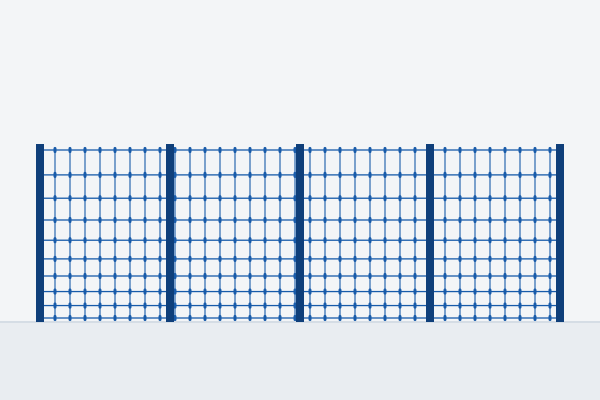
What is the cheapest fencing for a farm?
Measured by what you pay on day one, barbed wire and chain link cost least. A solar-powered electric fence also costs little upfront. Each stops different animals, and each lasts a different time:
| Fence | Upfront cost | What it stops | Upkeep | How long it lasts |
|---|---|---|---|---|
| Barbed wire (kantedar taar) | Low | Marks a boundary; wild boar and small animals walk between the strands | Regular checks and re-tensioning | Depends on its coating: ask for the GSM |
| Conventional galvanised chain link (jali) | Low | Most animals while it stands; sags between posts and is easily pushed over | Rust treatment, re-tensioning and post realignment every 2 to 3 years | 2 to 5 years in Indian conditions |
| Solar-powered electric fence (jhatka machine) | Low | Deters animals while it has power and is maintained | Power and regular upkeep; care around people and livestock | Depends on upkeep |
| SIMO Securon Pi knotted fence | Higher | Wild boar and smaller animals, at 5 to 6 ft with tight wires at ground level | Minimal | Rated for 10 years |
| SIMO Securon Zeta Nova knotted fence | Higher | Nilgai (blue bull), cattle and wild boar, at 6 ft | Minimal | Rated for 20 years |
A compound wall is a different choice, for privacy and noise rather than cost: see compound wall vs fencing.
Why does the cheapest fence not always cost least?
Three things decide what a fence really costs a farmer:
- The posts. Chain link needs a post every 2.5 to 3 metres; a high tensile knotted fence spans 5 to 6 metres. Every post is a hole to dig and concrete to pour, so around half the posts means less material, less labour and installation about 40 percent faster.
- The years it lasts. Conventional galvanised chain link usually lasts 2 to 5 years in Indian conditions. Over ten years, it is bought two to five times, with the labour each time. A SIMO Securon Pi fence is rated for 10 years.
- What a failed fence lets in. A fence that nilgai clear, or wild boar push under, costs the season’s crop it was meant to protect.
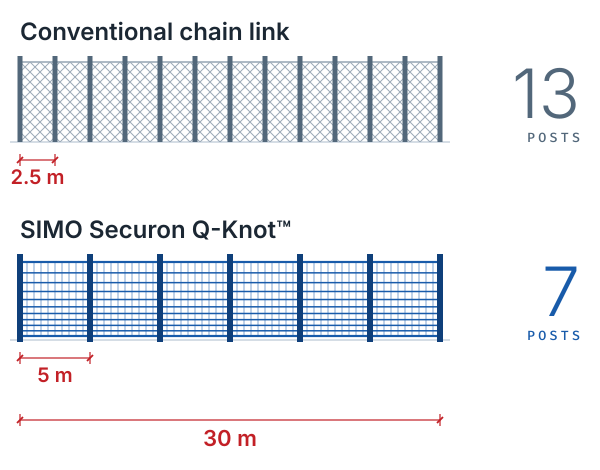
How do you compare farm fencing cost over the life of the fence?
Divide the installed cost of each fence (material, posts and labour) by the years it lasts, and add the upkeep. The fence with the lowest cost per year of life is the one that costs least, even if it costs more on day one.
| Square farm | Boundary | Knotted fence posts at 5 m | Chain link posts at 2.5 m |
|---|---|---|---|
| 1 acre (40 guntha) | 255 m (about 840 ft) | 51 | 102 |
| 2 acres | 360 m (about 1,180 ft) | 72 | 144 |
| 5 acres | 569 m (about 1,870 ft) | 114 | 228 |
Measured against conventional galvanised chain link over the life of the fence, a SIMO Securon knotted fence is:
- Pi: Up to 30 percent more cost effective.
- Zeta Nova: 10 to 20 percent more cost effective, and twice the life.
- Alpha: Up to 10 percent more cost effective, and longer lasting.
What sets the price of your fence
- the boundary length, and its corners and gates
- the height and the grade (Alpha, Zeta Nova or Pi)
- the ground, and the posts and foundations it needs
- toppings: RTHT™ barbed wire or concertina coil
- supply only, or supplied and installed by SIMO’s crews
Send these to the team and your exact price comes back on WhatsApp or by phone.
The step-by-step method is in fencing cost in India.
What about a solar-powered electric fence?
In India, “solar fencing” on a farm usually means an electric fence: wires carrying pulses from an energiser (jhatka machine) powered by a solar panel. It costs less upfront and deters animals where it is kept working, but it needs power, regular upkeep and care around people and livestock. A knotted fence is a physical barrier that keeps working with little upkeep and no power. SIMO Securon makes the physical fence, not electric fence energisers.
Which low cost fence suits your farm?
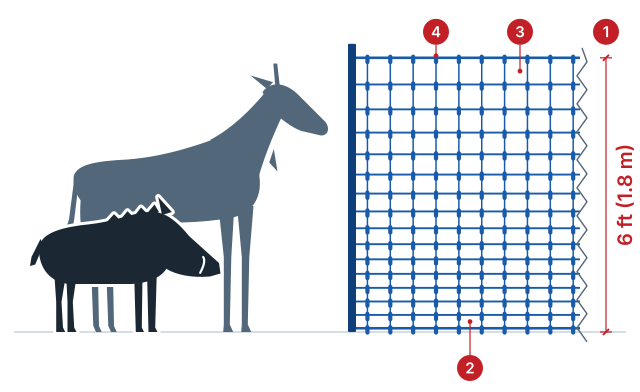
- Wild boar and smaller animals: the Pi knotted farm fence, SIMO Securon’s affordable grade, at 5 to 6 ft with the wires tight at ground level. Over its life, Pi is up to 30 percent more cost effective than conventional galvanised chain link.
- Nilgai and cattle: at least 6 ft. For nilgai and cattle, SIMO Securon usually suggests Zeta Nova or Alpha: see farm fencing.
- A boundary marker only: barbed wire, or SIMO Securon’s RTHT high tensile barbed wire, on its own.
Many states help with the cost of farm fencing: see the farm fencing subsidy guide, and ask your agriculture officer whether a knotted fence qualifies. Then let the fencing cost estimator work out the posts and rolls for your land.
FAQ
Low cost farm fencing questions
What is the cheapest fencing material for a farm?
To buy, barbed wire (kantedar taar) and chain link (jali) cost least. Barbed wire is a few strands on posts: it marks a boundary, but wild boar and small animals walk through the gaps between strands, and nilgai clear a low fence. Chain link closes the gaps, but sags between posts and usually lasts 2 to 5 years.
Is chain link cheaper than a knotted fence?
To buy, yes: conventional galvanised chain link costs less upfront. Over the life of the fence, a SIMO Securon knotted fence is more cost effective, because it needs around half the posts and lasts longer: up to 30 percent with Pi, 10 to 20 percent with Zeta Nova and up to 10 percent with Alpha.
Knotted fence vs chain linkIs a solar electric fence cheaper than a knotted fence?
A solar-powered electric fence (jhatka machine) usually costs less upfront, and deters animals where it is kept working. It needs power, regular upkeep and care around people and livestock. A knotted fence is a physical barrier that keeps working with little upkeep and no power.
How many posts does a cheap farm fence need?
It depends on the fence: chain link needs a post every 2.5 to 3 metres, while a high tensile knotted fence needs one every 5 to 6 metres. A square acre is about 255 metres around: about 102 posts for chain link at 2.5 metres, against about 51 for a knotted fence at 5 metres.
Is there a government subsidy for farm fencing?
Several states run farm fencing schemes, usually paying a share of the cost up to a cap per farmer, and many name barbed wire or solar fencing as the fence they fund. Ask your agriculture officer before you buy whether a knotted fence qualifies under your state's scheme.
Talk to the SIMO Securon team
Call or WhatsApp us with your site type, location and boundary length, and we will come back with a recommendation.