
Guide
Types of fence: a glossary of fence names in India and abroad
Last updated
The main types of fence in India are chain link (jali), barbed wire (kantedar taar), knotted fence (fixed knot or hinge joint), welded mesh panels, solar-powered electric fences and compound walls. This glossary explains each name buyers use, in India and abroad, and says which of them SIMO Securon makes.
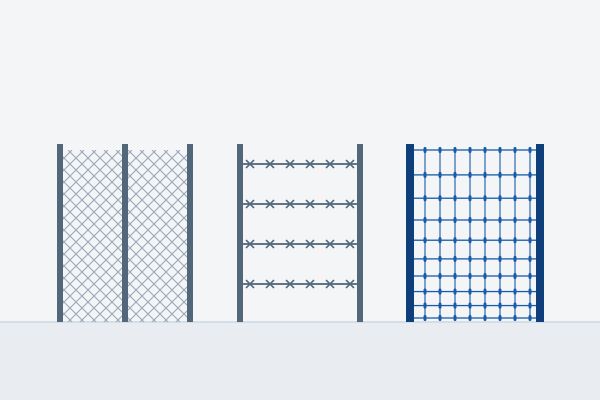
Wire fences: chain link, barbed wire and high tensile
- Chain link fenceAlso called jali, chain link mesh, diamond mesh
A fence of wires woven into diamonds, with no knots at the crossings, fixed to posts usually 2.5 to 3 metres apart. In India the standard is IS 2721; its 2025 revision covers galvanised and polymer-coated steel chain link fence fabric. It costs little upfront and closes the gaps that barbed wire leaves. Conventional galvanised chain link usually lasts 2 to 5 years in Indian conditions.
From SIMO Securon: Made to order under the QvikFixrr™ range, galvanised to IS 2721 or in Zeta Nova grade zinc-aluminium (Zn-Al).
- Barbed wireAlso called kantedar taar
Two wires twisted together, with short sharp barbs at intervals, strung in strands between posts. In India, galvanised steel barbed wire for fencing is made to IS 278, for which BIS has notified mandatory certification. It marks a boundary and deters people, but leaves open gaps between strands that small animals walk through.
From SIMO Securon: RTHT™, a reverse-twisted high tensile barbed wire (below).
- High tensile barbed wireAlso called HT barbed wire, reverse twist barbed wire
Barbed wire made from high tensile steel wire, which holds its tension over long runs and resists cutting. In a reverse-twisted wire, the direction of twist changes along its length.
From SIMO Securon: RTHT, reverse twisted, 15.5 x 15.5 SWG, 800 MPa, in Zeta Nova grade Zn-Al, in bundles of 200 m, 12 to 13 kg: used on top of a knotted fence, or on its own on farm boundaries.
- High tensile fenceAlso called HT fence, high tensile wire fence
A fence made from high tensile steel wire, much stronger than ordinary low-carbon fence wire. Definitions differ by country: a US Department of Agriculture specification calls for 12.5 gauge wire of at least 170,000 psi (about 1,170 MPa); a UK Forestry Commission guide gives a breaking strain of 1,050 N/mm².
From SIMO Securon: Q-Knot™ fence wire of 1150 to 1300 MPa in Alpha and Zeta Nova, and 850 to 900 MPa in Pi.
Knotted fences: fixed knot, hinge joint, deer, game and horse fence
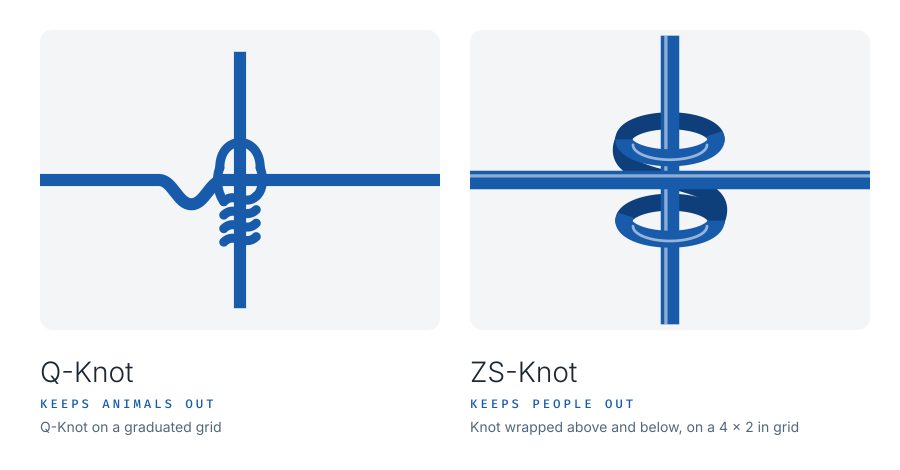
- Fixed knot fenceAlso called knotted fence, knot wire fence, locked joint fence, continuous stay fixed knot
A woven wire fence whose vertical stays are continuous wires, with a separate short wire wrapped round every crossing of stay and line wire, so the crossing is locked and cannot slip. That keeps it rigid enough for wide post spacing. In the UK it is called locked joint; in the US it is sold as deer fence, game fence, cattle fence and horse fence, by what it keeps in or out.
From SIMO Securon: The Q-Knot fixed knot fence, on a graduated grid, with posts 5 to 6 m apart in Alpha.
- Hinge joint fenceAlso called hinge knot fence, field fence, woven wire field fence
A woven wire fence whose vertical stays are separate short lengths of wire between the line wires, their ends wrapped round the line wires, so each joint can give under pressure and spring back. The joints can slide along the line wires, and the mesh can fold up when pushed from below. It needs posts closer together than a fixed knot fence.
From SIMO Securon: Not made by SIMO Securon.
- 4 x 2 inch knotted anti-climb fence (2 x 4)Also called 4 x 2 anti-climb fence, no-climb fence, non-climb fence
A knotted fence with line wires 4 inches apart and stays 2 inches apart: an opening too narrow for a toe or finger hold, so the 4 x 2 grid is hard to climb. In the US, fences with 2 x 4 inch openings are sold as non-climb (searched as no-climb) horse fence, usually woven with other kinds of knot.
From SIMO Securon: The ZS-Knot 4 x 2 inch anti-climb knotted fence, in Alpha and Zeta Nova, 6 ft and 8 ft, with wire of 700 to 800 MPa.
- Deer fence and game fenceAlso called deer fence, game fence, wildlife fence
Tall fences that keep deer and other wild animals in or out. A US state specification for deer fencing calls for high tensile fixed knot woven wire at least 96 inches (8 ft) high, and game fences there are usually 7 to 8 ft. In India the same kind of fence is used on forest, wildlife and zoo boundaries, and at 6 ft on farms against nilgai (blue bull) and wild boar.
From SIMO Securon: The Q-Knot fixed knot fence at 6 ft, and at 8 ft made to order in Alpha and Zeta Nova.
- Horse fence and cattle fenceAlso called horse fence, cattle fence, no-climb horse fence
Names for wire fences by the animals they keep in. In the US, fixed knot fence is sold as horse fence and cattle fence, and the 2 x 4 inch pattern as non-climb horse fence, so hooves and heads cannot go through. In India, a cattle fence must stand at least 6 ft against stray cattle and stay stiff when cattle lean on it.
From SIMO Securon: The Q-Knot fixed knot fence for cattle; the ZS-Knot 4 x 2 inch grid where a closer mesh is needed.
Panels, electric fences and walls
- Welded mesh panel (358)Also called 358 mesh, 358 fence, prison mesh, welded mesh fence
Rigid panels of wire welded at every crossing, clamped or bolted to posts. The 358 pattern has openings of about 76.2 x 12.7 mm (3 x 0.5 inch), usually of 4 mm wire; its name comes from 3 inch by 0.5 inch by 8 gauge. In India, an anti-climb fence often means these panels, which are a different product from a 4 x 2 inch knotted anti-climb fence.
From SIMO Securon: Not made by SIMO Securon. Its knotted answer is the ZS-Knot 4 x 2 inch anti-climb fence, supplied in rolls.
- Solar-powered electric fenceAlso called solar fencing, electric fence, jhatka machine
Plain wires carrying short high-voltage pulses from an energiser, powered by a solar panel and a battery. An animal that touches a wire gets a sharp, short but safe shock and learns to keep away. In India, 'solar fencing' on a farm usually means this kind of fence; it needs power, regular upkeep and care around people and livestock. Its energisers are covered by the Indian safety standard IS 302 (Part 2, Section 76), for which BIS has notified mandatory certification.
From SIMO Securon: SIMO Securon makes the physical fence, not electric fence energisers.
- Compound wallAlso called boundary wall, precast wall, masonry wall
A wall of brick, stone, blocks or precast concrete panels round a plot. It gives privacy and cuts noise, and it means heavy civil work and a longer build.
From SIMO Securon: SIMO Securon makes a fence, not a wall. Against a precast or masonry wall, its knotted fence has equivalent strength, installs twice as fast and needs far less civil work; where privacy or noise matters most, a wall is the right choice.
Posts and coatings
- Angle posts, RCC posts and FRP anglesAlso called fencing pole, cement pole, RCC pole, L angle post
Angle posts are steel posts of L-shaped section, galvanised or coated. RCC (reinforced cement concrete) posts are made to IS 4996, which describes farm fencing with line posts 3 m apart and strainer posts 30 m apart. FRP (fibre reinforced polymer) angles are made of glass fibres set in a resin, not steel, so like RCC posts they have no value as scrap.
From SIMO Securon: QvikFixrr angle posts, hot-dip galvanised or epoxy coated, on standard 8.5 ft shafts. On pilferage-free designs, RCC posts and FRP angles to the required specification and applicable standards.
- Zinc-aluminium (Zn-Al) coatingAlso called zinc aluminium coating, Galfan
A coating of zinc alloyed with aluminium, which protects steel wire both as a barrier and by sacrifice. Galfan, a registered trademark of Galfan Technology Centre LLC, is one such alloy, of about 95 percent zinc and 5 percent aluminium. The general name is zinc-aluminium, or Zn-Al.
From SIMO Securon: Zn-Al of 90 percent zinc and 10 percent aluminium on Alpha (Zn-Al 90/10, 240 GSM minimum) and Zeta Nova (Zn-Al 90/10, 120 GSM). SIMO's coating is not Galfan.
Which fence does SIMO Securon make?
SIMO Securon is a fixed knot fence manufacturer in Nagpur, India. It makes:
- the Q-Knot fixed knot fence, which keeps animals out, in three grades;
- the ZS-Knot 4 x 2 inch anti-climb knotted fence, which keeps people out, in Alpha and Zeta Nova;
- RTHT high tensile barbed wire, for the top of a fence or a farm boundary;
- QvikFixrr posts, fittings, concertina coil, tools, and chain link made to order.

It does not make hinge joint fence, welded mesh panels, electric fence energisers or walls. To choose between the types for your site, see how to choose the longest lasting fence, or let the fencing cost estimator suggest one.
FAQ
Questions about fence types
What are the main types of fence in India?
Chain link (jali), barbed wire (kantedar taar), knotted fence (fixed knot or hinge joint), welded mesh panels, solar-powered electric fences, and walls of brick, stone or precast concrete. Each suits a different job: a wall gives privacy, chain link costs little upfront, and a high tensile fixed knot fence stops animals over a long boundary.
What is the difference between a fixed knot and a hinge joint fence?
In a fixed knot fence, each vertical stay is one continuous wire and a separate small wire locks every crossing, so the mesh stays rigid. In a hinge joint fence, each stay is a separate short length wrapped round the line wires, so the joint can give and spring back, and the stays can slide.
Fixed knot vs hinge jointWhat is a 358 fence?
A 358 fence is a rigid welded mesh panel with openings about 76.2 x 12.7 mm (3 x 0.5 inch), usually of 4 mm wire, clamped or bolted to posts. The name comes from 3 inch by 0.5 inch by 8 gauge wire. It is a different product from a knotted fence.
What is a game fence?
A game fence is a tall fence, usually a high tensile fixed knot fence of 7 to 8 ft, built to keep deer and other wild animals in or out. In India the same kind of fence is used on forest and wildlife boundaries, and at 6 ft on farms against nilgai (blue bull).
Sources
- ASTM A116-22: Metallic-Coated, Steel-Woven Wire Fence Fabric (hinge joint and continuous stay fixed knot) (opens in a new tab), ASTM International
- Practice specification, Fence (Code 382), woven wire, Kentucky (opens in a new tab), USDA Natural Resources Conservation Service
- Construction specification 382, high-tensile smooth wire fence, Georgia (opens in a new tab), USDA Natural Resources Conservation Service
- Forest fencing, Technical Guide FCTG002 (opens in a new tab), Forestry Commission (UK)
- High-tensile woven wire deer fencing design and installation specifications (opens in a new tab), New Jersey Department of Agriculture
- At Issue, March 2003 (game fences) (opens in a new tab), Texas Parks and Wildlife magazine
- IS 2721:2025, chain link fence fabric (opens in a new tab), Bureau of Indian Standards
- IS 278:2009, galvanized steel barbed wire for fencing (opens in a new tab), Bureau of Indian Standards
- IS 302 (Part 2/Sec 76):1999, electric fence energizers (opens in a new tab), Bureau of Indian Standards
- IS 4996:1984, reinforced concrete fence posts (text) (opens in a new tab), Bureau of Indian Standards, via Public.Resource.Org
- Solar power fence (opens in a new tab), Tamil Nadu Agricultural University, TNAU Agritech Portal
- Fixed knot horse fence (product page) (opens in a new tab), A US fence maker, read 17 October 2026
- Non-climb horse fence, 2 x 4 inch (product page) (opens in a new tab), A US fence maker, read 17 October 2026
- 358 mesh panels: specification (product page) (opens in a new tab), A UK fence maker, read 17 October 2026
Talk to the SIMO Securon team
Call or WhatsApp us with your site type, location and boundary length, and we will come back with a recommendation.